
E-Bikes Fall Through a Legal Hole in New York: Why Injured Riders Can’t Use No-Fault Insurance
E-bike injury claims in New York are complicated by a critical gap in the state’s no-fault insurance law that leaves injured riders without the automatic medical coverage car accident victims receive. Understanding this gap is essential for any New York e-bike rider who wants real financial protection after a crash.
This guide focuses specifically on why New York’s no-fault insurance framework excludes most e-bike riders, and what legal options remain available to injured cyclists in the city and across the state.
No-Fault Insurance Gap for E-Bikes: New York’s no-fault auto insurance law (Insurance Law Article 51) covers injuries in motor vehicle accidents, but the state’s current classification of most e-bikes excludes them from triggering those benefits automatically.
Why No-Fault Insurance Exists – And Why E-Bikes Are Left Out
New York’s no-fault system was built to give car accident victims quick access to medical benefits without needing to prove fault first. It works well for traditional vehicle crashes. The problem is that the law was written long before e-bikes became a fixture on city streets.
Under New York Vehicle and Traffic Law, e-bikes are divided into three classes based on speed and pedal assistance. Class 1 and Class 2 e-bikes are legally classified as bicycles – not motor vehicles. That distinction can affect no-fault eligibility, but it does not automatically bar coverage in every e-bike crash. Since no-fault benefits attach to registered motor vehicles, an e-bike that is legally a bicycle doesn’t trigger coverage, even if it was involved in an accident with a car.
E-bike use in New York has grown substantially in recent years, with delivery workers and commuters among the most visible groups of daily riders. That surge in ridership hasn’t been matched by any meaningful update to the insurance statutes that govern what happens when those riders get hurt.
The most common mistake injured e-bike riders make is assuming the at-fault driver’s no-fault policy will cover them automatically. It doesn’t work that way. No-fault pays the insured vehicle owner’s occupants and qualifying pedestrians – not every person a car hits.
No-Fault vs. Third-Party Claims: Which Path Is Actually Open?
| Coverage Type | Available to E-Bike Riders? | Requires Proving Fault? | Covers Medical Bills? | Best For |
|---|---|---|---|---|
| No-Fault (PIP) | No (for Class 1/2 e-bikes) | No | Yes – up to $50,000 (2026) | Motor vehicle occupants only |
| Third-Party Liability Claim | Yes | Yes | Yes, if driver is liable | Riders hit by negligent drivers |
| Uninsured Motorist (UM) | Potentially, via lawsuit | Yes | Partial | Hit-and-run or uninsured driver cases |
| Personal Health Insurance | Yes | No | Yes, subject to deductibles | Immediate medical coverage gap |
Where third-party claims succeed: When a driver’s negligence directly caused the crash, an injured rider can pursue the at-fault driver’s liability insurance. This can cover medical expenses, lost wages, and pain and suffering.
Where third-party claims fail: They take time. Without no-fault to bridge the gap, injured riders may face delays in getting medical bills covered while a liability claim moves through the system.
Where no-fault succeeds: Speed and simplicity – victims don’t wait for fault determinations.
Where no-fault fails e-bike riders: It simply doesn’t apply under current New York law for most e-bike classifications.
The verdict: Injured e-bike riders in New York must rely on third-party liability claims and personal health insurance while pursuing compensation. A clear legal strategy matters from day one.
Thinking about this for your situation? Let’s talk. Contact us and we’ll walk you through your options – no pressure.
What the Classification Problem Really Means in 2026
New York law currently recognizes three e-bike classes. Class 3 e-bikes, which can reach 25 mph with pedal assist, sit in a gray zone that has generated ongoing legal debate. The question of how higher-speed e-bikes should be treated under New York insurance law remains an area of active discussion among legal practitioners. The legislature has not yet addressed this classification gap with a definitive statutory resolution.
Pedal-assist bicycle: An e-bike that provides motor assistance only while the rider pedals, capped at a specific speed limit under New York classification rules.
Throttle-controlled e-bike: A Class 2 e-bike where the motor operates independently of pedaling – still legally a bicycle in New York, still excluded from no-fault.
Recent data shows e-bike injuries in New York have risen each year since 2025, with a disproportionate share involving delivery workers. That population faces compounded challenges: no employer-provided coverage, no no-fault access, and physical jobs that make recovery delays especially costly.
Your E-Bike Injury Action Plan
- Step 1 – Seek immediate medical care: Document every injury from the start. Medical records are the foundation of any future claim, and gaps in treatment hurt your case.
- Step 2 – File a police report: Get a report number at the scene. This is critical evidence for any third-party liability claim against a driver.
- Step 3 – Photograph everything: Your e-bike, the vehicle, road conditions, and your injuries. Visual evidence fades fast.
- Step 4 – Collect witness information: Names and contact details from anyone who saw the crash.
- Step 5 – Notify your health insurer: Use personal health coverage immediately since no-fault won’t step in.
- Step 6 – Consult a personal injury attorney: New York’s statute of limitations for personal injury claims is generally three years, but acting quickly preserves evidence and protects your rights.
What to Gather Before a Legal Consultation
- ☐ Police report or report number
- ☐ Photos and videos from the scene
- ☐ Medical records and bills received so far
- ☐ Contact information for witnesses
- ☐ Insurance information from the at-fault driver
- ☐ Documentation of lost wages or missed work
- ☐ Your e-bike purchase records (showing its classification)
Key Takeaways for New York E-Bike Riders in 2026
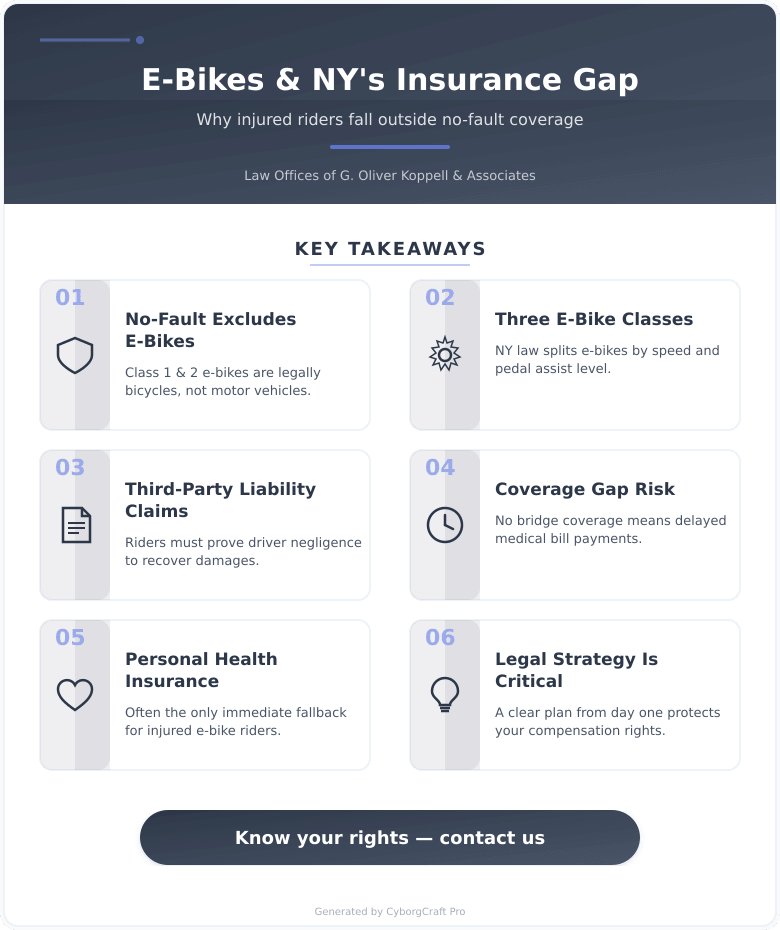
- No automatic no-fault coverage – most e-bikes are classified as bicycles under New York law, not motor vehicles
- Third-party liability claims are the primary path – injured riders pursue the at-fault driver’s insurance directly
- Personal health insurance fills the immediate gap – use it while a liability claim develops
- E-bike classification matters legally – the class of your bike affects your legal standing
- Act quickly – the three-year statute of limitations starts at the date of injury, and evidence disappears fast
Frequently Asked Questions
Can an e-bike rider in New York ever access no-fault benefits?
In limited circumstances, yes – if an e-bike rider is also a named insured on a personal auto policy, they may access no-fault benefits through that policy even as a cyclist. This exception is narrow and fact-specific, so it’s worth discussing with an attorney who handles New York injury claims.
What if the driver who hit me was uninsured?
You may have options through New York’s Motor Vehicle Accident Indemnification Corporation (MVAIC), which can provide compensation to certain injured pedestrians and cyclists hit by uninsured drivers. Eligibility rules apply, and filing deadlines are strict, so acting fast is important.
Does the type of e-bike I was riding change my legal rights?
Yes – the classification of your e-bike (Class 1, 2, or 3) can affect how courts and insurers treat your claim. Higher-speed Class 3 bikes face ongoing legal scrutiny, and some arguments exist for treating them differently under New York insurance law.
How long do e-bike injury claims typically take to resolve?
Third-party liability claims involving e-bike accidents in New York can take anywhere from several months to over a year depending on injury severity and insurer cooperation. Cases that go to litigation take longer, which is one reason building a strong claim file early matters so much.
Should I take the first settlement offer from the driver’s insurance?
Early settlement offers from insurers rarely reflect the full value of a claim, especially when long-term medical needs haven’t been fully assessed. Getting legal guidance before accepting any offer protects you from settling for less than your injuries are worth.
Do delivery workers on e-bikes have any additional coverage options?
Some delivery platforms offer occupational accident insurance for gig workers, which can cover injuries sustained while working. Coverage varies significantly between platforms, and these policies often have lower limits than traditional workers’ compensation – reviewing the actual policy language is essential.
What This Means for Riders Across New York
The legal gap affecting e-bike riders isn’t a minor technicality. It’s a real financial exposure that catches thousands of riders off guard every year. Whether you’re commuting through Manhattan, making deliveries in Brooklyn, or riding through neighborhoods in Queens or the Bronx, the same gap applies.
At Law Offices of G. Oliver Koppell & Associates, located at 99 Park Ave in New York, NY, we work with injured New Yorkers navigating exactly these kinds of complex insurance and liability questions. The law doesn’t always protect riders automatically – but knowing your rights changes everything.
For a full overview of how we can help, visit our services page. Ready to get real answers about your situation? Contact us today – consultations are free, and you pay nothing unless we win.
This content is for informational purposes only and does not constitute legal advice. For guidance specific to your situation, consult a qualified New York personal injury attorney.