
New York’s New E-Bike Crash Reporting Law Changed Who Can Be Held Liable – Here’s How
New York e-bike crash liability refers to the legal responsibility assigned to parties involved in electric bicycle accidents under New York’s updated crash reporting requirements. These rules directly affect how injury claims are investigated, documented, and pursued in court.
New York amended its crash-reporting rules for certain e-bike and e-scooter crashes effective July 11, 2025.
E-Bike Crash Reporting Law Definition: New York’s e-bike crash reporting law requires that accidents involving electric bicycles meeting specific speed and motor thresholds be formally reported to state authorities, creating an official record that courts and insurers use to establish fault and liability.
The most common mistake people make after an e-bike crash is assuming the rules mirror standard bicycle accident protocols. They don’t. Since 2025, New York has treated certain e-bike collisions under a reporting framework that pulls in elements from both motor vehicle law and traditional cycling regulations – and that hybrid status is exactly what reshapes who owes what to whom.
What the New Reporting Requirements Actually Say
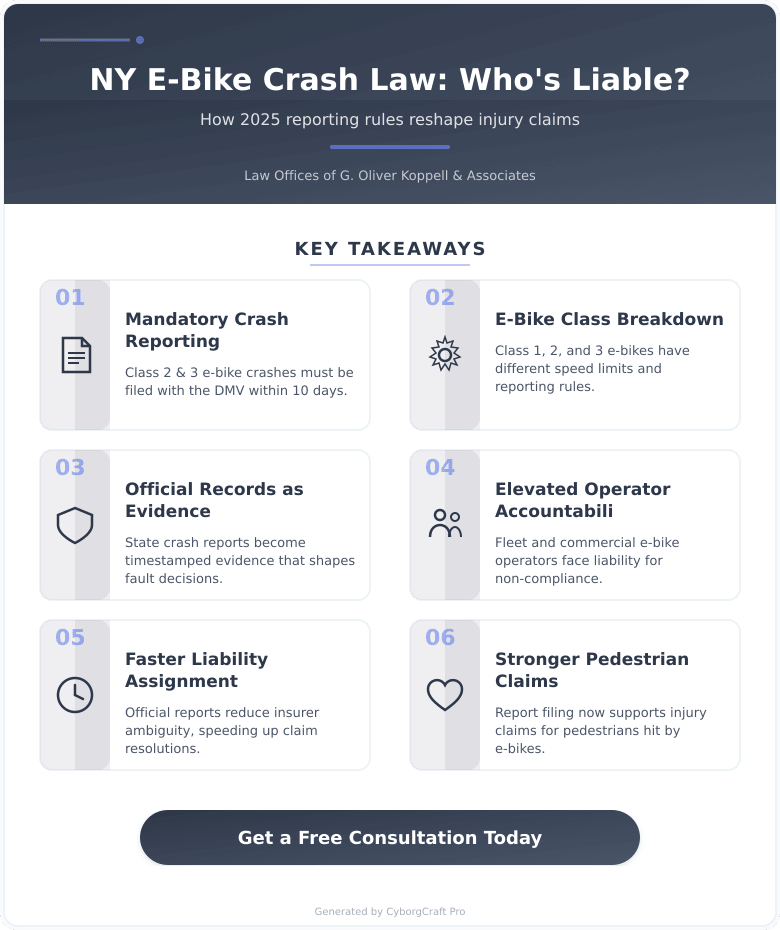
Under the updated New York framework, Class 2 and Class 3 e-bikes involved in crashes resulting in injury or property damage above a set threshold must be reported to the New York State Department of Motor Vehicles within 10 days. Class 1 e-bikes are subject to their own applicable requirements, and riders of any class should document crashes thoroughly since records affect liability in any civil claim.
Class breakdown that matters for liability:
- Class 1: Pedal-assist only, max 20 mph
- Class 2: Throttle-assisted, max 20 mph – full crash reporting triggers above injury/damage threshold
- Class 3: Pedal-assist, max 28 mph – subject to crash reporting requirements under the updated framework
E-bike use has grown significantly across major U.S. cities in recent years, and New York’s updated rules reflect the need for clearer reporting standards as these vehicles become more common on city streets.
How the Reporting Shift Changes Liability – The Core Issue
Here’s the thing: before this law, many e-bike crashes fell into a documentation gray zone. Police reports were inconsistent. Insurance companies disputed whether no-fault rules applied. Injured riders often had weak evidentiary footing.
The mandatory reporting requirement changes that in three concrete ways.
- Official records now exist: A formal crash report creates a timestamped, state-recognized document. That record becomes evidence in civil claims and shapes how insurers assign fault percentages.
- Operator accountability is elevated: Those involved in a crash involving a commercial or fleet e-bike have reporting obligations under the updated rules, and failure to comply with those obligations may be relevant in related civil proceedings.
- Driver liability is easier to establish: When a car strikes an e-bike and a proper report is filed, the driver’s insurance carrier loses some of the ambiguity it previously used to delay or deny claims.
Thinking about this for your situation? Let’s talk. Contact us for a free consultation – no pressure, just straight answers about where you stand.
Old Rules vs New Rules: What Changed for Injured Riders
| Factor | Pre-2025 Framework | Current Framework |
|---|---|---|
| Crash documentation | Inconsistent, often informal | Mandatory state filing for Class 2 and 3 |
| Liability assignment | Frequently disputed, slow | Faster with official report as anchor |
| Fleet company exposure | Limited unless negligence proven | Non-compliance itself is evidence of fault |
| No-fault insurance access | Largely unavailable to e-bike riders | Still limited, but reporting creates civil claim path |
| Pedestrian claims | Difficult without documentation | Report filing supports pedestrian injury claims |
Where the old framework succeeded: It kept administrative burdens low for casual riders and avoided over-regulating low-speed cycling.
Where the old framework failed: It left injured parties without reliable documentation, let fleet operators avoid accountability, and made insurance negotiations a guessing game.
Where the new framework succeeds: It creates an evidentiary record, holds commercial operators to a higher standard, and gives injured riders a stronger foundation for claims.
Where the new framework falls short: Enforcement is uneven, many riders are still unaware of the filing requirement, and missing the 10-day deadline can weaken an otherwise solid claim.
The verdict: The updated framework is a clear improvement for injured parties who know how to use it. The problem is that most people don’t – and gaps in compliance are already being exploited by insurers.
Your E-Bike Crash Action Plan
- Step 1 – Seek medical attention: Get evaluated immediately, even for minor injuries. Medical records dated close to the crash date are critical for any future claim.
- Step 2 – Call police and request a report number: A police report supports but does not replace the state DMV filing requirement for Class 2 and 3 bikes.
- Step 3 – File the MV-104 form within 10 days: This is the New York State crash report. Missing this window can complicate your liability claim significantly.
- Step 4 – Document the scene: Photos of the bike, vehicle positions, road conditions, and your injuries all support the official record.
- Step 5 – Consult an attorney before speaking to insurers: Statements made to the other party’s insurer before you understand the reporting law’s implications can reduce your recovery.
Crash Report Preparation Checklist
- ☐ Full name, address, and contact information of all parties
- ☐ E-bike classification (Class 1, 2, or 3) documented
- ☐ Photos of damage, road markings, and traffic signals
- ☐ Names and badge numbers of responding officers
- ☐ Witness contact information
- ☐ Completed MV-104 form filed with New York DMV within 10 days
- ☐ Medical evaluation records from date of injury
See how the Law Offices of G. Oliver Koppell & Associates handles e-bike crash claims for clients across New York, including Manhattan, the Bronx, Brooklyn, Queens, and Staten Island. For a complete overview of how we approach these cases, visit our services page.
Common Mistakes That Hurt Your Claim
The most common mistake we see is riders assuming a police report is enough. It isn’t. The state DMV filing is a separate requirement, and skipping it hands the other side’s attorney a procedural argument against you.
- Waiting more than 10 days to file the MV-104 report
- Misidentifying your e-bike class, which affects which rules apply
- Accepting a quick insurance settlement before understanding the full injury picture
- Failing to document fleet or employer ownership of a delivery e-bike involved in the crash
According to New York courts, comparative negligence applies in e-bike crashes – meaning your compensation can be reduced proportionally if you’re found partially at fault. Proper documentation and timely reporting directly affect that calculation.
What This Means for You Right Now
If you or someone you know was hurt in an e-bike crash in New York, the clock is already running – both on the 10-day reporting requirement and on the three-year statute of limitations for personal injury claims under New York law. Serving clients throughout New York, NY and surrounding communities, the team at Law Offices of G. Oliver Koppell & Associates at 99 Park Ave #1100, New York, NY 10016 understands how these reporting rules interact with liability claims under the current framework.
Ready to understand your options? Contact us today for a free consultation. The sooner you act, the stronger your position.
Frequently Asked Questions
Does the new e-bike crash reporting law apply to all electric bikes in New York?
The mandatory crash reporting requirement primarily applies to Class 2 and Class 3 e-bikes involved in crashes that cause injury or significant property damage. Class 1 e-bikes face their own applicable requirements, but riders of any class should document crashes thoroughly since records affect liability in any civil claim.
What happens if I miss the 10-day filing deadline?
Missing the 10-day window to file the MV-104 crash report with New York DMV weakens your evidentiary position but does not automatically bar your injury claim. Courts may consider the late filing in evaluating the reliability of your account, and insurance adjusters will use the gap to negotiate down settlement offers.
Can a delivery company be held liable for an e-bike crash caused by one of its riders?
Yes – under New York’s updated framework, those operating commercial e-bike fleets face potential liability exposure related to crashes involving their riders. Failure to meet applicable legal obligations may be relevant in civil proceedings, particularly when the company knew or should have known about its responsibilities under the law.
How long do I have to file a personal injury lawsuit after an e-bike crash in New York?
New York’s statute of limitations for personal injury claims is generally three years from the date of the crash. Claims against government entities have a much shorter window – sometimes as little as 90 days – so getting legal advice quickly is important regardless of who caused the accident.
Does no-fault insurance cover e-bike injuries in New York?
No-fault insurance is generally not available to e-bike riders in New York because most e-bikes are not classified as motor vehicles under the no-fault statute. Injured riders typically pursue claims through the at-fault party’s liability coverage or through their own uninsured/underinsured motorist coverage if applicable.
What is comparative negligence and how does it affect my e-bike crash claim?
Comparative negligence means your financial recovery is reduced by the percentage of fault assigned to you. In New York, you can still recover damages even if you were partially at fault, but proper crash documentation and timely reporting directly affect how that fault percentage is calculated.