
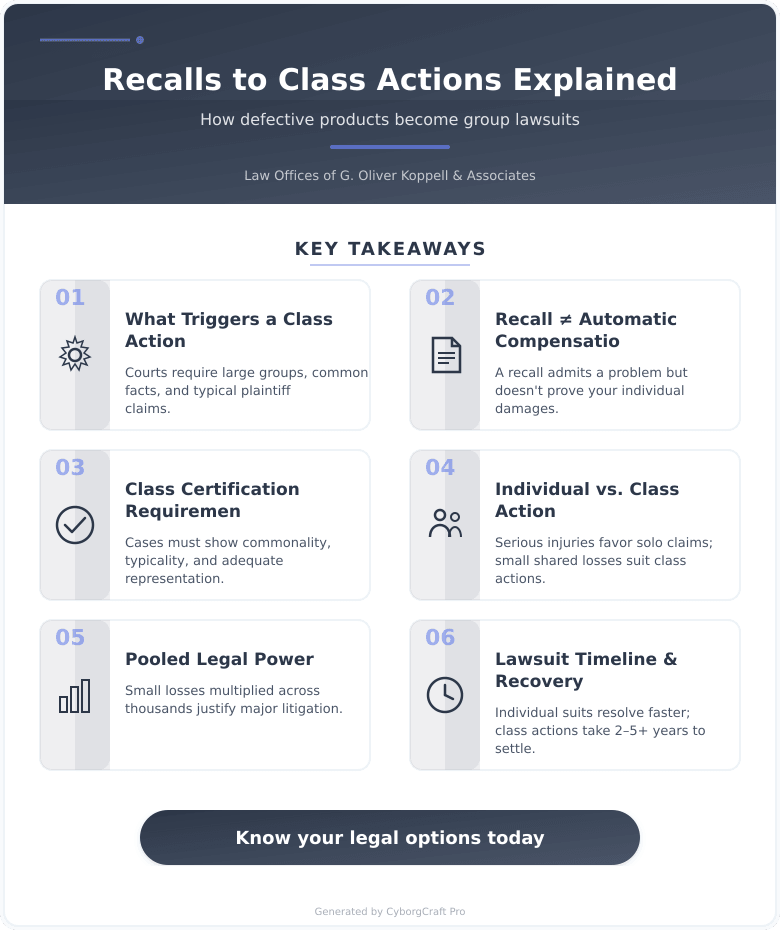
When a Product Recall Becomes a Class Action: How Defective Goods Turn Into Group Lawsuits
A product recall class action is a consolidated lawsuit filed on behalf of a large group of consumers who suffered harm from the same defective product or unsafe goods. These cases allow injured parties to pursue accountability together, making litigation viable even when individual damages might be too small to justify a solo lawsuit.
This guide focuses specifically on how product recalls escalate into class action lawsuits, who qualifies to join, and what New York consumers should know before taking action.
Recalls happen constantly. The U.S. Consumer Product Safety Commission issues dozens of product recalls every year, covering everything from children’s toys to kitchen appliances to auto parts. But a recall announcement doesn’t automatically mean the company is held financially responsible. That’s where class action litigation enters the picture.
What Triggers a Class Action After a Product Recall?
Not every recall leads to a lawsuit, and not every lawsuit becomes a class action. For a group case to move forward, courts generally require a few things to be true.
Class certification elements under federal and New York rules:
- The class must be large enough that individual cases would be impractical (typically dozens to thousands of affected consumers)
- The legal questions and facts must be common across all plaintiffs
- The named plaintiffs’ claims must be typical of the broader group
- The named plaintiffs must adequately represent the class
Recent data shows that defective product cases involving recalls are among the most frequently certified class actions in federal court. When a company issues a recall and consumers can show they were harmed before or despite that recall, courts often find the commonality requirement satisfied quickly.
The most common mistake we see is consumers assuming the recall itself is enough to guarantee compensation. A recall is an admission of a problem, not automatic proof of your damages. You still need to demonstrate you were injured or financially harmed.
Individual Lawsuit vs. Class Action: Which Approach Works?
Where individual lawsuits succeed: Higher individual damages, unique injury circumstances, or cases where your losses far exceed what the average class member experienced. Personal injury with significant medical bills often fits here.
Where individual lawsuits fail: When damages per person are modest (say, the cost of a $40 recalled blender), financing solo litigation becomes impossible. Attorneys work on contingency for serious injuries, but small-dollar cases rarely attract individual representation.
Where class actions succeed: They pool resources and legal firepower. A $40 loss times 500,000 consumers equals $20 million in potential damages, which absolutely justifies litigation. Class cases also create systemic accountability that deters future misconduct.
Where class actions fail: Individual recovery is often smaller after attorneys’ fees and distribution. Class members have limited control over settlement terms. If you suffered severe personal injuries, a class settlement may undercompensate you compared to a standalone claim.
The verdict: If your injuries are serious and your damages are substantial, pursuing an individual claim or opting out of a class settlement to sue separately may serve you better. If your losses are moderate and shared by many others, joining or leading a class action is usually the more practical path.
| Lawsuit Type | Typical Timeline | Individual Recovery | Best For |
|---|---|---|---|
| Individual Product Liability | 1-3 years | Full damages retained | Serious injury, high medical costs |
| Class Action Settlement | 2-5 years | Pro-rata share after fees | Widespread, lower-dollar harm |
| Mass Tort (MDL) | 3-7 years | Individually negotiated | Serious injuries, many plaintiffs |
Thinking about which path fits your situation? Contact us for a straightforward conversation about your options. No pressure, no commitments.
How a Product Recall Turns Into a Filed Class Action
Phase 1: Harm Identification and Investigation (1-6 Months)
Attorneys track recall announcements, consumer complaints, and regulatory filings. They identify patterns suggesting widespread harm and begin building a factual record.
Key actions during this phase:
- Collect consumer complaints and injury reports
- Analyze recall scope and company communications
- Identify potential named plaintiffs willing to represent the class
Phase 2: Filing and Class Certification (6-18 Months)
The complaint is filed in federal or state court. Plaintiffs then move for class certification, the critical step where a judge decides whether the case can proceed as a group action rather than individual claims.
Key actions during this phase:
- File the complaint naming the defective product and manufacturer
- Submit evidence meeting certification requirements
- Defend against company motions to dismiss or decertify
Phase 3: Discovery and Negotiation (12-36 Months)
Both sides exchange documents and conduct depositions. Most class actions settle before trial. Courts must approve any settlement to confirm it’s fair to all class members.
Your Product Recall Class Action Action Plan
- Step 1 – Document Everything: Keep the defective product if safe to do so, save receipts, photograph any injuries or property damage, and note medical treatment dates.
- Step 2 – Register with the Recall: Follow the manufacturer’s recall instructions to preserve your rights, but understand this doesn’t waive your right to sue.
- Step 3 – Track the Statute of Limitations: In New York, product liability claims generally carry a three-year statute of limitations from the date of injury. Missing this deadline ends your claim.
- Step 4 – Research Existing Litigation: Search federal court records or legal news sources to determine if a class action has already been filed for your product.
- Step 5 – Consult an Attorney: Get a legal opinion on whether joining an existing class or filing separately serves your interests best before any deadlines pass.
Documents to gather before your consultation:
- ☐ Proof of purchase (receipt, credit card statement, online order confirmation)
- ☐ Recall notice or CPSC announcement reference number
- ☐ Photos of the product, defect, and any resulting damage or injury
- ☐ Medical records and bills related to any injuries
- ☐ Any communications with the manufacturer or retailer
What New York Consumers Should Know Specifically
New York courts apply Article 9 of the Civil Practice Law and Rules (CPLR) to class actions filed in state court. Federal cases follow Rule 23 of the Federal Rules of Civil Procedure. The filing venue, state versus federal, can affect your timeline and recovery options significantly.
New York also has strong consumer protection statutes, including General Business Law Sections 349 and 350, which prohibit deceptive acts and false advertising. These provisions can support class claims even when physical injury is limited, allowing consumers to recover damages for being deceived into purchasing an unsafe product.
At Law Offices of G. Oliver Koppell & Associates, located in New York, NY, our team works with consumers navigating exactly these questions. Understanding which legal theory fits your situation, product liability, consumer fraud, or breach of warranty, shapes every strategic decision that follows.
According to the CPSC, hundreds of product categories were subject to recall actions through early 2026, with consumer goods and children’s products among the most frequently affected categories. That volume of recalls means class action filings are consistently active in federal courts throughout the country, including the Southern District of New York.
Common Mistakes That Derail Class Action Claims
- Waiting too long: New York’s statute of limitations is strict. Three years sounds like a long time until it isn’t.
- Accepting a recall remedy without understanding your rights: Taking a coupon or product replacement from the manufacturer does not necessarily waive your litigation rights, but some agreements might. Read the fine print.
- Discarding the product: Physical evidence matters. Preserve the defective item whenever possible.
- Assuming class membership is automatic: You may need to file a claim form within a specific deadline to receive any settlement benefit.
Frequently Asked Questions
How do I know if a class action already exists for a recalled product?
Search the federal court system’s PACER database or legal news outlets like Law360 for filings related to the product name or manufacturer. Your attorney can also run a thorough search as part of an initial consultation.
Can I opt out of a class action and sue on my own?
Yes, class members typically have the right to opt out during a court-specified period and pursue individual claims instead. This makes sense when your personal damages are significantly higher than what the class settlement offers.
How much does it cost to join a class action lawsuit?
Class action plaintiffs generally pay nothing upfront because attorneys work on a contingency fee basis, earning a percentage of the settlement only if the case succeeds. The court must approve attorney fees in any class settlement.
What is the statute of limitations for product liability in New York?
New York generally allows three years from the date of injury to file a product liability claim (2026). Discovery rules can extend this in limited circumstances, but waiting is always risky.
What compensation can class members recover?
Class members may recover economic damages like the purchase price, repair costs, or medical bills, plus potentially statutory damages under New York’s consumer protection laws. Punitive damages are rare but possible in cases involving egregious corporate conduct.
Does a product recall prove the manufacturer was negligent?
A recall is strong evidence of a known defect but does not automatically establish legal negligence or liability. Plaintiffs must still connect the defect to their specific harm through evidence and legal argument.
How long does a class action lawsuit typically take?
Most class action cases resolve in two to five years, though complex cases can run longer depending on court schedules and the scope of litigation. Settlement negotiations often occur before trial, which can shorten the timeline.
Key Takeaways for New York Consumers in 2026
- Recalls don’t guarantee compensation – you still need to demonstrate harm and connect it to the defect
- Class actions work best for widespread, moderate-dollar losses – serious individual injuries may warrant separate claims
- New York’s three-year statute of limitations is firm – act before it closes your options
- Document everything immediately – physical evidence and purchase records make or break these cases
- Consumer protection laws add leverage – New York’s GBL Sections 349 and 350 can support claims even without physical injury
What This Means for You Right Now
If you purchased a recalled product in 2026 and suffered any harm, financial or physical, the window to act is open but not permanent. The legal process is long, and starting early always helps. Whether a class action already exists, whether you should join it or opt out, and whether New York state or federal court is the right venue, these are decisions worth making with proper guidance rather than guesswork.
Ready to get straight answers about your situation? Contact us today and we’ll walk you through exactly where you stand and what your realistic options look like. For a full overview of how we work, visit the Law Offices of G. Oliver Koppell & Associates homepage or explore our services page.
This content is for general informational purposes only and does not constitute legal advice. Reading this post does not create an attorney-client relationship. Consult a licensed New York attorney for advice specific to your situation.