
The Medical Malpractice Mistakes That Quietly Destroy Strong Cases Before They Begin
Medical malpractice mistakes are procedural and evidentiary errors that eliminate a patient’s legal claim before it ever reaches a courtroom. Catching these early is the difference between full compensation and walking away with nothing.
This guide focuses specifically on the pre-filing errors that cost New York patients their cases, and what to do instead.
The most common mistake we see is not the one that happened in the operating room. It’s what happens in the weeks and months after. Patients with genuinely strong claims quietly disqualify themselves through avoidable missteps. If you or someone you love suspects medical negligence, understanding these traps is urgent.
Why Medical Malpractice Cases Collapse Early
New York medical malpractice law imposes specific and demanding requirements on plaintiffs. Under New York State Courts guidelines, plaintiffs carry a high burden of proof. You must show a provider deviated from accepted medical standards and that the deviation directly caused your injury. That’s a two-part test. Failing either part ends the case.
A significant number of medical malpractice claims never result in a payment to the patient, and a meaningful portion of those failures trace back to early errors, not weak underlying facts.
Standard of care: The level of skill and treatment that a reasonably competent medical professional in the same field would provide under similar circumstances.
Causation: The legal requirement to prove the provider’s deviation directly caused the patient’s specific harm, not just that harm occurred.
Medical Malpractice Mistakes That Sink Strong Cases
Here’s what actually goes wrong, and why it matters more than most people realize.
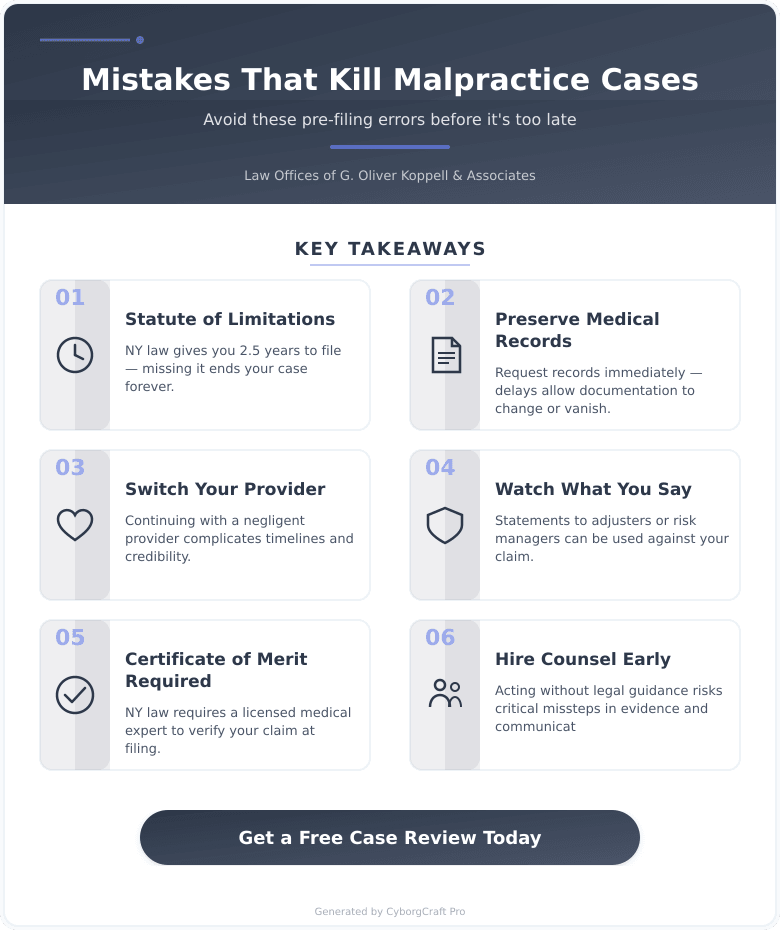
Waiting too long to act. New York’s statute of limitations for medical malpractice is two and a half years from the date of the act or omission, or from the end of continuous treatment by the responsible provider. Miss that window and no attorney can help you, no matter how clear-cut the negligence. The clock starts quietly. Many patients don’t realize it’s running.
Failing to preserve medical records immediately. Providers can amend, supplement, or in rare cases lose records. Requesting your complete records right away creates a baseline. Delays give documentation time to change or disappear. Patients have the right to request and obtain their own medical records, and exercising that right immediately is an important early step.
Continuing treatment with the same provider. This feels counterintuitive. But staying with a negligent provider extends the statute of limitations clock in a way that can confuse the timeline and complicate your claim. Switching to an independent provider can help clarify the harm timeline and protect your credibility.
Talking too much, too soon. Patients often speak openly with hospital risk managers, insurance adjusters, or even other treating physicians without realizing those conversations can be used against them. Anything you say about your condition, your symptoms, or what you understood about your treatment becomes part of the record.
Assuming the case is obvious. Even when negligence seems glaring, New York law requires a certificate of merit filed with or shortly after the complaint. This means an attorney must certify that a licensed medical professional has reviewed the case and confirmed a viable basis for the claim. Skipping proper professional review early is a fast path to dismissal.
Thinking about this for your situation? Let’s talk. Contact us and we’ll walk you through your options with no pressure.
Acting Fast vs. Acting Without Counsel: Which Approach Works?
| Approach | Advantages | Weaknesses | Best For |
|---|---|---|---|
| Acting fast without counsel | Preserves time, gathers records early | Missteps in communication, no professional review | Early evidence preservation only |
| Waiting to hire counsel | More time to assess severity | Statute of limitations risk, lost evidence | No one – delay adds risk |
| Retaining counsel early | Professional review, protected communications, deadline tracking | Requires finding qualified representation quickly | Anyone with a potential claim |
Where acting fast without counsel succeeds: You preserve records, document symptoms, and photograph any visible evidence before it fades.
Where acting fast without counsel fails: You may inadvertently give statements that undermine your claim or skip professional review requirements.
Where retaining counsel early succeeds: Every communication is protected, deadlines are tracked, and a medical professional reviews your case before a single filing error occurs.
Where retaining counsel early fails: Early consultation allows an attorney to identify issues before they become irreversible, making it a low-risk step for anyone with a potential claim.
The verdict: Preserve your records immediately, then get legal guidance before taking any other steps. The two actions are not mutually exclusive and both are time-sensitive.
Your Medical Malpractice Action Plan
- Step 1 – Request records immediately: Submit a written request for all records, imaging, notes, and correspondence on the day you suspect negligence. This creates a timestamped baseline.
- Step 2 – Document your symptoms and timeline: Write down every symptom, every conversation, every date. Memory fades. Written notes become evidence.
- Step 3 – Switch treating providers: Transfer your care to an independent provider who has no connection to the original treatment. This protects your credibility and clarifies the harm timeline.
- Step 4 – Avoid all informal discussions: Do not speak with hospital representatives, insurers, or anyone connected to the provider without legal counsel present.
- Step 5 – Consult a New York attorney: New York’s certificate of merit requirement means your case needs qualified medical professional review before filing. An attorney manages this and tracks your statute of limitations deadline from day one.
What New York Patients Need to Gather Before a Consultation
- ☐ Complete medical records from the treating provider
- ☐ Records from any follow-up or emergency care
- ☐ Written timeline of events, symptoms, and conversations
- ☐ Correspondence from the provider or hospital
- ☐ Insurance explanation of benefits documents
- ☐ Names and contact info of any witnesses
- ☐ Photographs of visible injuries or physical conditions
Key Takeaways for New York Patients in 2026
- The statute of limitations is 2.5 years – but it starts sooner than most people expect and has narrow exceptions.
- Early documentation wins cases – records requested immediately cannot be retroactively altered as easily.
- Informal statements are dangerous – anything said to a risk manager or adjuster can surface at trial.
- New York requires a certificate of merit – professional review is not optional, it’s a filing requirement.
- Waiting costs more than acting – the most common regret in 2026 medical malpractice claims is delayed legal consultation.
Frequently Asked Questions
What is the statute of limitations for medical malpractice in New York?
New York’s statute of limitations for medical malpractice is two and a half years from the date of the malpractice or from the end of continuous treatment by the same provider. There are limited exceptions, including a discovery rule for foreign objects left in the body, but these are narrow and courts apply them strictly.
What medical malpractice mistakes most commonly destroy cases?
The most damaging medical malpractice mistakes are waiting too long to consult an attorney, failing to request records immediately, and making informal statements to hospital staff or insurers. Each of these errors can independently eliminate an otherwise valid claim before it is ever filed.
Do I need an professional witness for a medical malpractice case in New York?
Yes. New York requires a certificate of merit, which means an attorney must certify that a licensed medical professional reviewed the case and found a valid basis for the claim. Without this, the case can be dismissed at the outset.
How much does a medical malpractice attorney cost in New York?
Most medical malpractice attorneys in New York handle cases on a contingency fee basis, meaning you pay no upfront fees and the attorney collects a percentage only if you win. New York law caps contingency fees in medical malpractice cases on a sliding scale based on recovery amount, under Judiciary Law Section 474-a (2026).
Can I still file if I continued treatment with the same provider?
You may still be able to file, but continuing treatment with the same provider extends and complicates the timeline in ways that require careful legal analysis. The continuous treatment doctrine affects when the statute of limitations clock starts and stops, and courts apply it case by case.
How long does a medical malpractice case take in New York?
Medical malpractice cases in New York typically take two to five years from filing to resolution, depending on complexity, court scheduling, and whether the case settles or goes to trial. Cases that begin with strong documentation and early legal involvement tend to move more efficiently.
What should I look for when choosing a medical malpractice attorney?
Look for an attorney who conducts a genuine case review before making any promises, explains New York’s certificate of merit requirement, and tracks your statute of limitations deadline from the first consultation. Honest, direct communication about the strength of your claim matters more than any marketing claim.
Your Next Step Starts Today
Medical malpractice cases in New York are unforgiving of early errors. The evidence you preserve in the first weeks, the statements you avoid making, and the counsel you retain before filing shape everything that follows. Every day of delay is a day the statute of limitations moves closer and documentation becomes harder to secure.
At Law Offices of G. Oliver Koppell & Associates, located in New York, NY, we work with patients across Manhattan and surrounding communities to protect their rights from the very first step. If you suspect medical negligence, the time to act is now.
Ready to understand your options? Contact us today for straight answers about your situation. There is no pressure and no obligation.