
What a Former Attorney General Knows That Most Injury Lawyers Don’t About Fighting Institutions
Fighting institutions in personal injury cases is the legal process of holding powerful organizations – hospitals, government agencies, corporations, and insurers – accountable when their actions or negligence harm individuals. It requires a fundamentally different strategy than standard injury litigation because institutions have structural advantages, deep resources, and legal teams built specifically to minimize payouts.
This guide focuses specifically on how institutional defendants differ from individual defendants, and what strategic knowledge makes the difference between a case that settles fairly and one that gets buried.
Most injury attorneys handle claims against individuals or small businesses. Suing a hospital system, a city agency, or a large corporation is a different exercise entirely. The pattern we see most often is that injured people hire lawyers who know personal injury but don’t know institutions – and they pay for that gap.
Why Institutional Defendants Play a Different Game
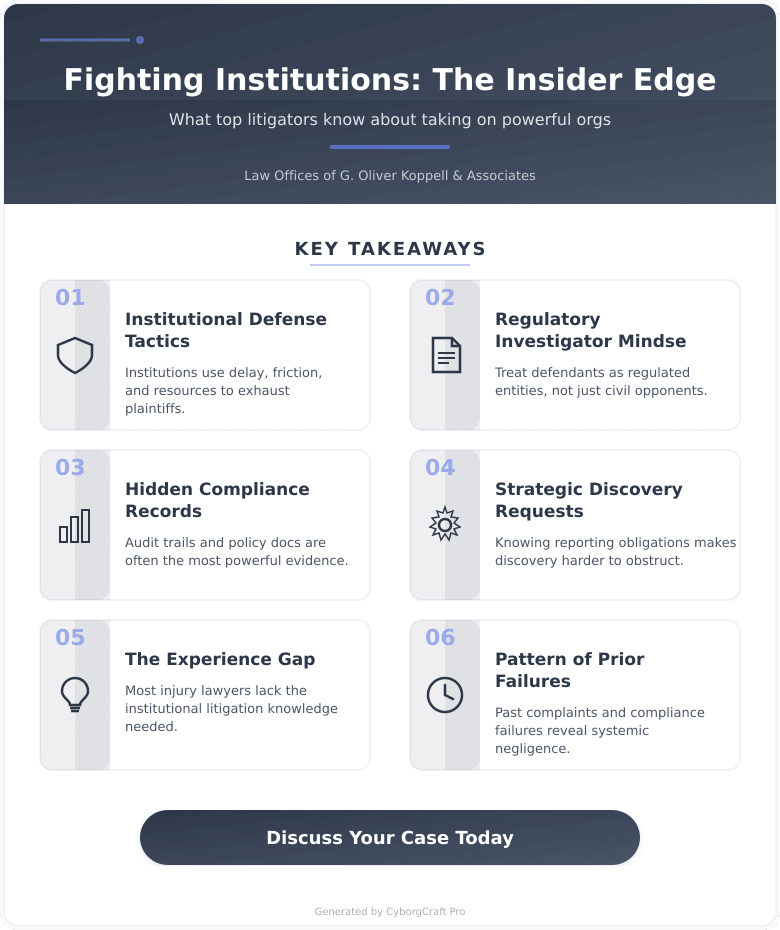
Large institutions don’t respond to claims the way individuals do. A hospital, transit authority, or insurance conglomerate has in-house legal teams whose job is to slow cases down, exhaust plaintiffs, and create procedural friction until people give up or accept low settlements.
Research consistently shows that unrepresented plaintiffs recover significantly less against institutional defendants than those with legal counsel. That gap doesn’t happen by accident. It’s engineered.
Here’s what makes institutional defense uniquely powerful:
- Large institutions often have dedicated in-house legal teams and substantial outside-counsel budgets.
- Decades of institutional memory about which arguments work
- Pre-built discovery obstruction protocols
- Relationships with local courts and claims administrators
- Financial capacity to delay cases until plaintiffs need money
Pattern recognition: The most common mistake we see is injury attorneys treating institutional defendants like private individuals – expecting good-faith document disclosure, assuming cooperation during discovery, and underestimating how aggressively an institution will protect internal records.
The Attorney General Advantage: Thinking Like a Regulator
Former attorneys general and senior government prosecutors understand something most private litigators don’t: institutions are shaped by regulation, and their internal compliance records, audit trails, and policy documents are often the most powerful evidence available.
When a government attorney investigates a corporation, they don’t just look at what happened on the day of the incident. They look at internal communications, prior complaints, compliance failures, and the gap between what an institution says its policies are and what it actually does. That investigative lens – applied to civil injury litigation – changes everything.
Regulatory investigation framework: Our approach is based on treating institutional defendants as regulated entities first and civil defendants second. That means understanding their reporting obligations, their accreditation requirements, and the records they’re legally required to maintain – then using that knowledge to build discovery requests they can’t easily ignore.
Attorneys who understand regulatory compliance are increasingly recognized as better equipped to pursue institutional defendants effectively, bringing a strategic advantage that traditional personal injury practice alone may not provide.
Thinking about your case against an institution? Contact us for a direct conversation about your options – no pressure, no obligation.
Individual Attorney vs. Institutional Litigation Experience: Which Approach Works?
Where standard personal injury practice succeeds: Efficient resolution of car accident claims, clear liability cases, and claims against individuals or small insurers. Strong negotiation skills and medical record analysis apply directly.
Where standard personal injury practice fails: Discovery against institutions requires knowing what records legally must exist. Deposing corporate witnesses demands understanding how internal hierarchies and approval chains work. Standard demand letters don’t create the same pressure on institutional risk managers as they do on individual defendants.
Where institutional litigation experience succeeds: Understanding how to use regulatory frameworks as leverage. Knowing how to identify and demand specific internal audit records. Recognizing when an institution’s public statements contradict its internal policies – which is often the foundation of punitive damage claims.
Where institutional litigation experience fails: Cases require more preparation time and resources upfront. The extended timeline can be financially difficult for injured plaintiffs who need resolution quickly.
The verdict: For cases against hospitals, government agencies, large employers, or corporate defendants, institutional litigation experience is not optional – it’s the deciding factor. A lawyer who hasn’t navigated regulatory discovery and corporate depositions will consistently underperform against institutional defense teams.
| Case Type | Typical Timeline | Discovery Complexity | Key Leverage Point |
|---|---|---|---|
| Individual defendant | 6-18 months | Low to moderate | Insurance policy limits |
| Small business defendant | 12-24 months | Moderate | Commercial liability coverage |
| Hospital or health system | 18-36 months | High – regulatory records required | Internal incident reports, accreditation files |
| Government agency (NY) | 24-48 months | Very high – notice of claim required | Prior complaints, policy violations |
| Large corporation | 24-48 months | Very high – multi-jurisdictional | Compliance gaps, executive communications |
Your Institutional Injury Case Action Plan
- Step 1 – File a Notice of Claim (if applicable): In New York, claims against government entities require a Notice of Claim filed within 90 days of the incident. Missing this deadline can permanently bar your case regardless of merit.
- Step 2 – Preserve all evidence immediately: Request surveillance footage, incident reports, and maintenance logs before institutions can argue records were destroyed per routine policy.
- Step 3 – Research the institution’s regulatory history: OSHA records, accreditation reviews, and prior complaints are public or discoverable. These documents establish patterns that transform individual incidents into systemic failures.
- Step 4 – Build a discovery strategy around compliance obligations: Institutions are legally required to maintain specific records. Knowing which records must exist – and demanding them specifically – prevents selective disclosure.
- Step 5 – Identify all potentially liable entities: Hospital systems, parent corporations, contractors, and insurers may each carry separate liability. Missing a defendant early can limit your recovery later.
- Step 6 – Prepare for long-game tactics: Institutional defendants often make lowball offers early and delay cases hoping plaintiffs grow desperate. Having a litigation team prepared to go to trial changes the negotiating dynamic entirely.
For a complete overview of how Law Offices of G. Oliver Koppell & Associates approaches complex civil litigation in New York, visit our services page.
What Injured New Yorkers Should Gather Before Any Consultation
- ☐ Incident reports filed by the institution
- ☐ All medical records related to the injury
- ☐ Any communications received from the institution or their insurer
- ☐ Witness names and contact information
- ☐ Photos or video of the incident scene
- ☐ Employment records if injury affects your work capacity
- ☐ Documentation of all expenses related to the injury
Common Mistakes That Derail Institutional Injury Cases
Mistake 1 – Waiting too long: New York’s statute of limitations for most personal injury claims is three years, but claims against government entities require a Notice of Claim within 90 days. This remains one of the most common reasons valid cases are dismissed.
Mistake 2 – Accepting early settlement offers: Institutions make fast, low offers precisely because early settlement is cheaper. Most injured plaintiffs don’t know the full extent of their damages when the first offer arrives.
Mistake 3 – Failing to demand regulatory records: Internal audit records, prior incident reports, and compliance files can establish that an institution knew about a dangerous condition and ignored it. Many attorneys never request these documents.
Mistake 4 – Underestimating the institution’s memory: Large organizations maintain detailed litigation histories. Their defense teams know which arguments worked before. Your legal team needs to anticipate those defenses in advance, not react to them mid-case.
According to the United States Courts, civil cases involving institutional defendants take significantly longer to resolve than cases against individual defendants – reinforcing why strategic preparation matters from day one.
Key Takeaways for Injured New Yorkers
- Institutional defendants are not like individual defendants – they have structural advantages that require a different legal approach.
- Regulatory knowledge is a major asset – understanding what records institutions must legally maintain shapes discovery strategy entirely.
- Deadlines are unforgiving – the 90-day Notice of Claim requirement for government entities is strict and courts rarely grant exceptions.
- Early settlement offers are almost always low – institutions make fast offers to limit exposure before you understand your full damages.
- Choosing the right legal team matters enormously – the gap in outcomes between lawyers who understand institutional litigation and those who don’t is measurable and significant.
Frequently Asked Questions
What makes fighting an institutional defendant different from a standard injury claim?
Institutional defendants have dedicated legal teams, deep resources, and established delay tactics that standard personal injury litigation doesn’t anticipate. They use discovery obstruction, procedural delays, and early lowball settlements strategically. Countering these requires attorneys who understand regulatory compliance and institutional behavior, not just personal injury procedure.
How long does a personal injury case against a hospital or government agency take in New York?
Cases against New York hospitals typically resolve in 18 to 36 months, while government agency cases can take 24 to 48 months or longer. Timeline depends on discovery complexity, the institution’s litigation posture, and whether the case goes to trial. Planning for a longer timeline is essential when suing large organizations.
What is the Notice of Claim requirement for New York government entity cases?
A Notice of Claim is a formal legal document that must be filed within 90 days of an injury caused by a New York government agency, transit authority, or municipality. Missing this deadline typically bars the claim permanently. This requirement applies before any lawsuit is filed and is separate from the general statute of limitations.
How do attorneys calculate damages in institutional injury cases?
Damages include medical expenses, lost income, future care costs, and pain and suffering – but institutional cases may also support punitive damages when systemic negligence is established. Proving a pattern of prior incidents or regulatory violations can significantly increase the value of a case beyond compensatory damages alone.
When should I contact an attorney after an injury involving an institution?
Contact an attorney immediately – within days of the incident if possible. Evidence disappears quickly, institutions begin building their defense from day one, and government entity deadlines are as short as 90 days. Waiting, even briefly, can limit your options significantly.
Do I need a lawyer to sue a large institution, or can I handle it myself?
Representing yourself against an institutional defendant is almost always a significant disadvantage. These organizations have experienced legal teams, established litigation protocols, and no obligation to help you navigate complex discovery or procedural requirements. Having legal representation levels the playing field in a meaningful way.
Your Next Step
If you or someone close to you was injured because of a hospital’s negligence, a government agency’s failure, or a corporation’s disregard for safety, the strength of your legal team matters more than in almost any other type of case. Institutions count on injured people choosing attorneys who aren’t prepared for the fight ahead.
The attorneys at Law Offices of G. Oliver Koppell & Associates, serving clients throughout New York City and the surrounding region from our office at 99 Park Ave, New York, NY, bring a perspective to institutional litigation that most injury practices simply don’t have. Ready to talk through your situation? Contact us today for a free consultation and straight answers about what your case actually involves.
Disclaimer: This content is provided for general informational purposes only and does not constitute legal advice. Reading this content does not create an attorney-client relationship. If you have a legal matter, consult a licensed New York attorney about your specific situation.