
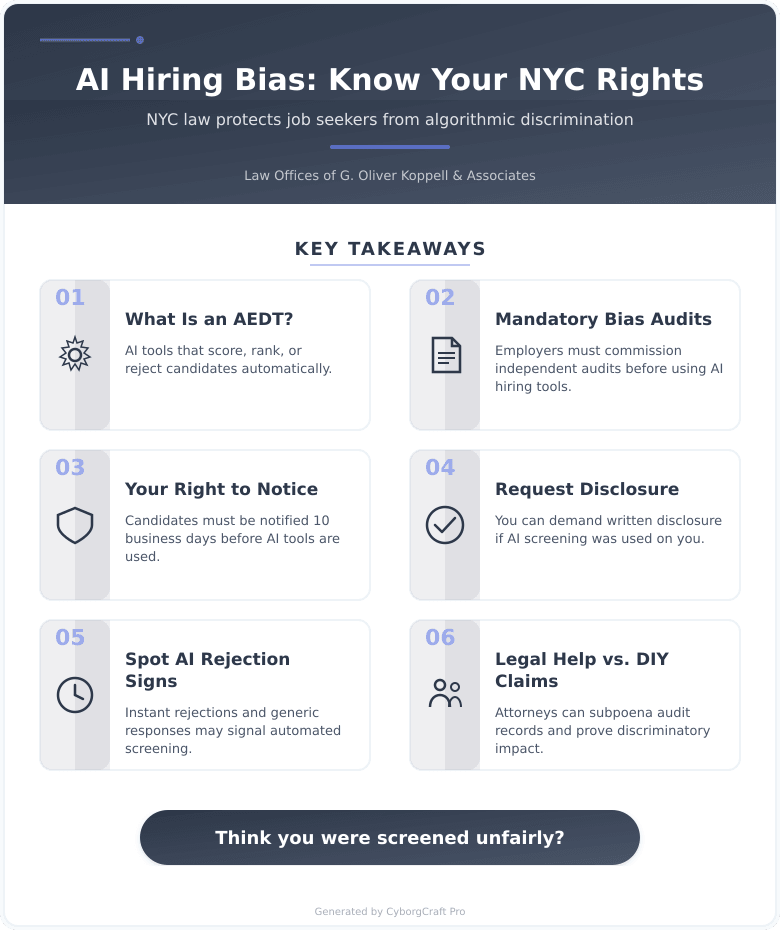
Two-Thirds of Employers Now Use AI to Reject Candidates: Your Rights Under NYC’s Bias-Audit Law
NYC AI hiring bias law is a municipal regulation requiring employers who use automated employment decision tools to conduct independent bias audits and notify candidates before those tools are used. It exists to protect workers from discriminatory outcomes driven by algorithmic screening systems that most applicants never even know are running.
This guide focuses specifically on NYC job seekers who suspect AI-driven hiring tools screened them out unfairly and want to understand their legal options under New York City’s bias-audit requirements.
Here’s a reality worth sitting with: a significant and growing number of employers now use some form of automated decision-making tool to filter, rank, or reject job candidates. That means the first to evaluate your resume may not be a person at all. And if that system carries a built-in bias against your age, gender, race, or disability status, you may have a real legal claim under NYC law.
The most common mistake candidates make is assuming AI rejection is just a quirk of the job market. It’s not always that. Sometimes it’s a violation of the law.
What NYC’s Automated Employment Decision Tool Law Actually Requires
Automated Employment Decision Tool (AEDT): Any computational process derived from machine learning, statistical modeling, or artificial intelligence that issues simplified output, including scores, classifications, or recommendations, used to make or assist employment decisions.
Under New York City Human Rights Law and the AEDT rules that took effect since 2023 and expanded in enforcement scope since 2025, employers and employment agencies operating in NYC must meet these baseline requirements:
- Commission an independent bias audit of any AEDT before using it
- Publish a summary of that audit on their public website
- Notify candidates and employees at least ten business days before the tool is used on them
- Disclose what data the tool collects and what job qualifications it evaluates
- Offer a reasonable accommodation or alternative process upon request
If an employer skipped any of those steps, they may be in violation before the AI even touched your application.
Knowing If AI Screening Was Used on Your Application
Most applicants never find out. That’s part of the problem. But there are signals worth watching for. If you applied for a position in New York City and received an automated rejection within minutes or hours of submitting, if you were never contacted by a human recruiter, or if you received a rejection that felt strangely generic for a role you were clearly qualified for, an AEDT may have been involved.
Under current 2026 rules, you have the right to ask. Employers covered by the NYC AEDT law must respond to written requests for disclosure. Document everything: the job posting, your application, timestamps, and any correspondence. That paper trail matters if you pursue a claim.
Thinking about this for your situation? Let’s talk. The team at Law Offices of G. Oliver Koppell & Associates can help you figure out whether what happened to you crosses a legal line. No pressure, just straight answers. Contact us to get started.
DIY Complaint vs. Legal Representation: Which Approach Works?
Where filing a complaint on your own succeeds: Lower cost, faster initial submission, and useful for clear-cut employer violations like missing audit disclosures.
Where filing on your own fails: Employers have legal teams. Proving discriminatory impact from an opaque algorithm is technically complex. Missed procedural steps can weaken your claim.
Where legal representation succeeds: Attorneys can subpoena audit records, evaluate disparate impact data, and navigate the NYC Commission on Human Rights process effectively. They understand which evidence carries weight.
Where legal representation fails: It takes time and involves upfront conversations about the strength of your case before committing to a path.
The verdict: For straightforward disclosure violations, a complaint through the NYC Commission on Human Rights is a reasonable first step. For cases involving potential discriminatory bias tied to a protected class, legal guidance significantly improves your position.
| Approach | Cost Range | Timeline | Best For |
|---|---|---|---|
| Self-filed complaint (NYC CCHR) | No filing fee | 6-18 months | Disclosure violations, straightforward cases |
| Attorney-assisted complaint | Varies by firm; many work on contingency | 6-24 months | Discriminatory impact claims, complex audits |
| Federal EEOC complaint | No filing fee | 6-12 months to right-to-sue | Interstate employers, federal discrimination claims |
Your NYC AI Bias Claim: Action Plan
- Step 1 – Preserve Evidence: Screenshot the job posting, your application confirmation, any automated rejection messages, and timestamps. Do this immediately.
- Step 2 – Request Disclosure: Send a written request to the employer asking whether an AEDT was used, what data it collected, and whether a bias audit was completed. Keep a copy.
- Step 3 – Review the Audit Summary: If the employer published an audit on their website, review it. Look for whether your demographic group showed statistically different selection rates.
- Step 4 – File with the NYC Commission on Human Rights: If the employer violated notice or audit requirements, file a complaint. Be mindful of applicable deadlines, as the NYC Human Rights Law imposes time limits on when complaints must be filed.
- Step 5 – Consult an Attorney: Before accepting any outcome, speak with a lawyer. Bias-audit claims can intersect with broader discrimination law under the NYC Human Rights Law, which is one of the strongest in the country.
What Employers in Neighboring States Must Do by Comparison
| State/City | AI Hiring Law | Audit Requirement | Candidate Notice Required |
|---|---|---|---|
| New York City, NY | Yes (AEDT Law, 2026) | Independent bias audit required | Yes, 10 business days |
| New York State | Proposed legislation only | None statewide yet | No |
| New Jersey | No specific AI hiring law | None | No |
| Connecticut | No specific AI hiring law | None | No |
| Pennsylvania | No specific AI hiring law | None | No |
NYC’s law is one of the strongest worker-facing AI protections in the country as of 2026. That matters if you work in New York City, even if the employer is headquartered elsewhere.
Common Mistakes That Hurt Your Claim
- Waiting too long to act – the clock on your complaint starts from the date of the violation
- Not requesting written disclosure from the employer before assuming a violation occurred
- Assuming the audit summary clears the employer – audit quality varies widely
- Conflating AI rejection with discrimination without connecting it to a protected class
- Missing the intersection with NYC Human Rights Law, which covers more protected categories than federal law
See how our approach compares – visit our services page to understand how we handle employment discrimination matters in New York City.
Key Takeaways for NYC Job Seekers in 2026
- AI hiring tools are now mainstream – a significant and growing share of employers use some form of automated screening
- NYC law requires bias audits – employers must complete and publish independent audits before using AEDTs
- You have a right to notice – employers must tell you before an AEDT evaluates you
- Evidence preservation is step one – screenshots and timestamps make or break a claim
- Filing deadlines apply – you have time, but acting sooner keeps evidence fresh
Frequently Asked Questions
What is NYC’s Automated Employment Decision Tool law?
NYC’s AEDT law requires employers using AI-based hiring tools to conduct independent bias audits and notify candidates before those tools are applied to their applications. Employers must also publish audit summaries publicly and provide a process for candidates to request an alternative evaluation method.
Can I sue an employer for using AI to reject my job application?
You may have a legal claim if an employer failed to follow NYC’s AEDT disclosure requirements or if the AI tool produced outcomes that discriminate based on a protected class. Claims can be filed with the NYC Commission on Human Rights or through civil litigation depending on the facts.
How do I know if an AI tool was used on my application?
You have the right to ask employers in writing whether an AEDT was used on your application under NYC law. Signs an AI tool may have been involved include near-instant rejections, no human recruiter contact, and generic rejection language despite a strong application.
What is the statute of limitations for an NYC AI bias complaint?
The NYC Human Rights Law imposes a deadline from the date of the discriminatory act to file a complaint. Acting sooner is advisable because evidence like audit records and application data becomes harder to obtain over time.
Does NYC’s AI hiring law apply if the company is based in another state?
Yes, the law applies if the job is based in New York City or the candidate is located in NYC at the time of the application. Employer headquarters in New Jersey, Connecticut, or Pennsylvania does not exempt the company from NYC’s AEDT requirements.
What protected classes does NYC’s Human Rights Law cover?
The NYC Human Rights Law covers more protected categories than federal law, including age, race, gender, disability, sexual orientation, immigration status, and several others. This broader scope means AI tools that produce biased outputs across any of these categories may trigger a valid claim.
Do I need a lawyer to file an AI hiring bias complaint in NYC?
You can file directly with the NYC Commission on Human Rights without an attorney, but legal guidance significantly strengthens cases involving algorithmic bias and discriminatory impact analysis. Most employment attorneys offer a free initial consultation to assess the merits of your situation.
What This Means for NYC Workers Right Now
The job market in New York City is competitive enough without an unchecked algorithm stacking the deck against you. If you applied for a role in 2026 and something felt off about how quickly or strangely you were rejected, you deserve a real answer about what happened.
The team at Law Offices of G. Oliver Koppell & Associates, located at 99 Park Ave in New York, NY, handles employment matters for workers across the city. If you think an automated hiring tool may have discriminated against you, we’ll give you a clear picture of where you stand. Reach out today – understanding your rights costs nothing, and waiting could mean losing them.
This content is for informational purposes only and does not constitute legal advice. Reading this post does not create an attorney-client relationship. Consult a licensed attorney for guidance specific to your situation.