
You Can Still Sue for Childhood Abuse in New York Until Age 55: What the Child Victims Act Actually Allows
The Child Victims Act is a New York law that extended the civil statute of limitations for childhood sexual abuse survivors, allowing them to file lawsuits until age 55 and criminal complaints until age 28. It reflects a broader recognition that survivors may face significant barriers before they are able to come forward and seek justice.
This guide focuses specifically on civil claims under the Child Victims Act for adult survivors seeking justice in New York.
If you experienced childhood abuse and assumed your window to act had closed, you may be wrong. New York’s Child Victims Act changed the rules significantly – and survivors across the state have used it to hold abusers and institutions accountable. Understanding what the law actually allows is the first step.
For personalized guidance, contact us at the Law Offices of G. Oliver Koppell & Associates for a free, confidential consultation with no pressure to proceed.
What the Child Victims Act Actually Changed
Child Victims Act Definition: The Child Victims Act (CVA) is a New York State law, signed in 2019, that extended civil and criminal deadlines for survivors of childhood sexual abuse and opened a one-time window allowing previously time-barred cases to be filed.
Before the CVA, New York’s civil deadline for childhood abuse claims was age 23. That meant survivors who came forward after their early twenties had no legal recourse – regardless of how serious the abuse was or who committed it.
The CVA changed three key things:
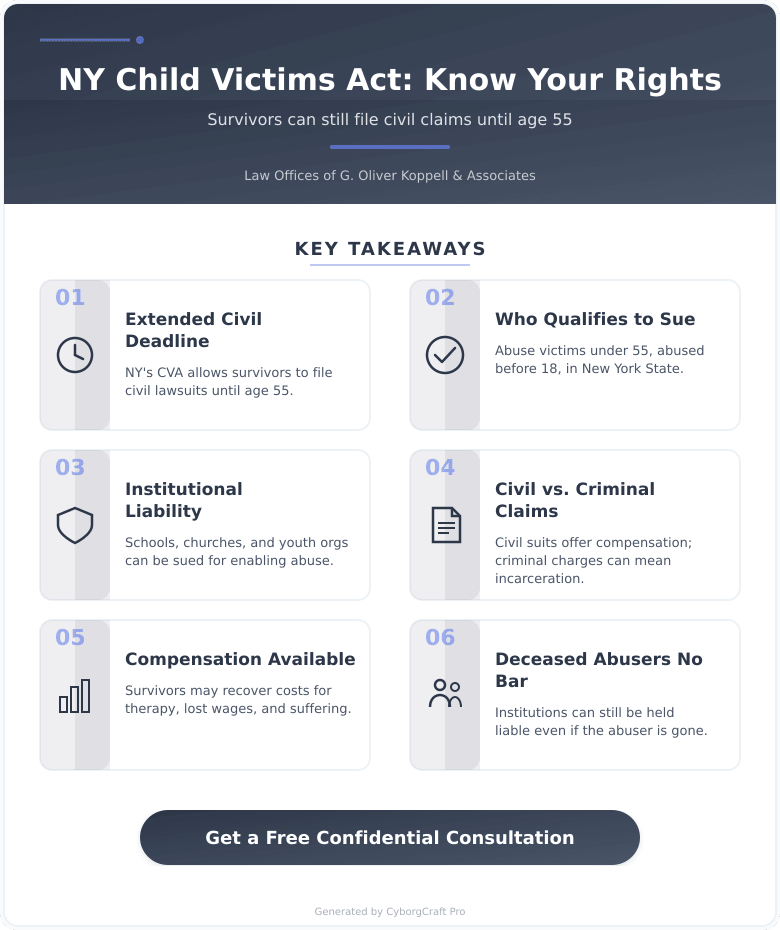
- Civil lawsuit deadline extended to age 55
- Criminal complaint deadline extended to age 28
- A one-time “lookback window” that allowed previously expired claims to be filed (that window has now closed, but the extended deadlines remain active for ongoing claims)
The lookback window saw significant participation from survivors across the state, a sign of how many had been silenced by the old rules.
Who Can File a Claim Under the Child Victims Act
You may have a valid civil claim if:
- You experienced sexual abuse before age 18
- You are currently under age 55
- The abuse occurred in New York State
- The abuser was a person or an institution (schools, religious organizations, youth programs, etc.)
Institutional liability is one of the most significant aspects of the CVA. Survivors can sue not just the individual who committed the abuse, but also organizations that knew – or should have known – and failed to stop it. Think schools, churches, sports programs, and youth organizations.
It is worth understanding that even if the direct abuser is deceased or unreachable, a case may not be over. Institutions can still be held liable independently.
Pattern Recognition: In cases involving institutional defendants, the evidence of prior complaints or internal cover-ups often becomes central to proving negligence. Organizations rarely abuse in isolation – they enable it.
Thinking about this for your situation? Let’s talk. We’ll walk you through your options – no pressure. Reach out here to start the conversation.
Civil Claims vs Criminal Charges: Which Approach Works?
Where civil claims succeed: They can result in financial compensation for medical costs, therapy, lost wages, and pain and suffering. Survivors control the timeline and aren’t dependent on a prosecutor’s decision to pursue the case. Institutions with assets can be targeted directly.
Where civil claims fall short: They do not result in criminal punishment for the abuser. Winning a civil case does not mean the abuser goes to prison. Evidence standards differ, and collecting damages from individuals with limited assets can be difficult.
Where criminal charges succeed: They carry the full weight of state prosecution and can result in incarceration. The state bears the burden of proof, not the survivor.
Where criminal charges fall short: The deadline is shorter (age 28 under the CVA). Prosecutors have discretion over which cases to pursue. Survivors have less control over the process and outcome.
The verdict: Many survivors pursue both civil and criminal avenues when possible. Civil litigation often makes sense even when criminal prosecution is not viable because the burden of proof is lower and the potential for institutional accountability is higher. An attorney can help you evaluate which path – or combination – fits your circumstances.
| Route | Deadline (CVA) | Who Files | Outcome | Best For |
|---|---|---|---|---|
| Civil Lawsuit | Age 55 | Survivor (with attorney) | Financial compensation | Institutional accountability, damages |
| Criminal Complaint | Age 28 | State prosecutor | Potential incarceration | Criminal punishment of abuser |
Your Child Victims Act Action Plan
- Step 1 – Confirm eligibility: Verify you are under 55, the abuse occurred in New York before age 18, and the event falls within the CVA’s scope. An attorney can assess this quickly in a free consultation.
- Step 2 – Gather documentation: Collect any records that may support your claim – therapy notes, medical records, prior complaints, witness contacts, or any written communications.
- Step 3 – Identify all defendants: The abuser is one potential defendant. Any organization that enabled or concealed the abuse may also be liable. Don’t assume you know all your options without legal review.
- Step 4 – Consult an attorney: Many attorneys handling CVA civil cases offer flexible fee arrangements. Discuss fee structures and costs during your initial consultation so you understand your options before moving forward.
- Step 5 – File before the deadline: The civil deadline is age 55. While that may feel distant, evidence fades, witnesses become unavailable, and institutional records get harder to obtain. Acting sooner protects your case.
Documents to Gather Before Your Consultation
- ☐ Any medical or mental health records referencing the abuse
- ☐ Names and contact information for potential witnesses
- ☐ Prior complaints made to schools, religious institutions, or police
- ☐ Correspondence with the abuser or the institution
- ☐ Employment records if lost wages are part of your claim
- ☐ A written timeline of events as you remember them
Common Mistakes That Can Hurt Your Case
Survivors often wait too long, assuming the process will be painful or fruitless. The CVA was designed to reduce those barriers – but waiting still carries risk. Evidence becomes harder to locate. Institutions may destroy records (sometimes illegally, which creates its own legal issue).
A second mistake is speaking with the institution or its attorneys without legal representation. Anything said can be used to minimize or deny the claim. Do not accept settlements or sign releases without a lawyer reviewing them first.
Third, some survivors assume they need a police report or prior criminal conviction to file a civil claim. They don’t. Civil and criminal cases operate independently.
Key Takeaways for Survivors in 2026
- The civil deadline is age 55 – New York’s Child Victims Act gives survivors more time than almost any other state
- Institutions can be sued – Schools, churches, and youth organizations face direct liability under the CVA
- No criminal conviction required – Civil cases stand on their own standard of proof
- No upfront legal fees – Most CVA attorneys work on contingency
- Acting early protects your claim – Evidence preservation is time-sensitive even when the legal deadline is years away
Frequently Asked Questions
What is the statute of limitations under the Child Victims Act in New York?
Under the Child Victims Act, survivors of childhood sexual abuse in New York can file a civil lawsuit until age 55. The criminal complaint deadline is age 28. These are significant expansions from the previous limits, which cut off at age 23 for civil claims.
Can I sue a school or church under the Child Victims Act?
Yes, institutions including schools, religious organizations, and youth programs can be sued under the CVA if they failed to prevent or report abuse. Institutional liability is central to many CVA claims and often where the largest recoveries occur.
Do I need a police report to file a civil case?
No police report is required to file a civil lawsuit under the Child Victims Act. Civil and criminal cases are independent. Many successful civil cases involve abuse that was never reported to law enforcement.
How much does it cost to hire a CVA attorney?
Most attorneys handling Child Victims Act cases work on a contingency basis, meaning no fees are charged unless the case resolves in your favor. General industry contingency rates in personal injury and civil rights cases typically range from 25% to 40% of the recovery, depending on case complexity and stage of litigation.
What if the abuser is deceased?
If the individual abuser has died, you may still be able to pursue claims against institutions that enabled or concealed the abuse. Institutional defendants with assets are often the more viable path regardless of whether the individual abuser is alive.
How long do Child Victims Act cases take to resolve?
CVA civil cases vary widely, but most take between one and four years to resolve depending on whether the case settles or goes to trial. Cases against large institutions with many plaintiffs sometimes involve coordinated proceedings that can affect timelines.
Does the Child Victims Act cover non-sexual physical abuse?
The Child Victims Act specifically addresses sexual abuse of minors, not all forms of childhood abuse. Other claims, such as physical abuse or neglect, may be governed by different statutes with different deadlines. An attorney can help identify which laws apply to your specific situation.
What This Means for You Right Now
New York’s Child Victims Act gave survivors a real, meaningful chance to seek accountability. But “until age 55” is not the same as “forever.” Evidence fades. Records disappear. Witnesses move or die. The gap between having a legal right and being able to prove a case grows with time.
The team at the Law Offices of G. Oliver Koppell & Associates in New York, NY serves clients throughout the five boroughs, Westchester County, the Bronx, Brooklyn, Queens, Manhattan, and surrounding communities. We understand that reaching out about childhood abuse takes courage – and we treat every conversation with the confidentiality and respect it deserves.
Ready to understand your options? Contact us today for a free, confidential consultation. There’s no obligation, no pressure, and no fee unless we win your case. The law is on your side – let’s make sure it works for you.