
A Black Real Estate Agent Just Won $788,000 for Racial Bias – What That Verdict Means for NY Workers
Racial bias in the workplace is a form of unlawful discrimination where an employer treats a worker differently based on race, resulting in lost income, career harm, or a hostile work environment. When courts hold employers accountable, those verdicts signal how seriously New York takes these protections.
This guide focuses specifically on what a recent racial bias verdict means for workers in New York and what steps you can take if you’ve experienced similar treatment.
A jury recently awarded a Black real estate agent a substantial sum after finding that racial bias played a direct role in how she was treated professionally. The verdict didn’t just change her life – it sent a clear message through New York’s employment law community. Racial discrimination claims are winnable, and juries are paying attention. If you’ve faced something similar at work, this outcome matters to you.
What the Verdict Actually Decided
The case resulted in a significant damages award reflecting the court’s findings on the impact of racial discrimination in a professional setting. Awards of this size reflect how seriously New York courts and juries treat proven racial discrimination cases.
Compensatory damages: Money awarded to compensate a plaintiff for actual losses, including lost income, emotional distress, and career damage caused by discrimination.
Punitive damages: Additional money a court may award to punish an employer for especially egregious conduct and to deter future violations.
According to the U.S. Equal Employment Opportunity Commission, race discrimination charges consistently rank among the most common complaint types filed each year. Recent data shows that retaliation and race discrimination together represent a substantial share of all EEOC charges filed nationally – a figure that underscores how widespread these issues remain.
Racial Bias Claims in New York: Stronger Protections Than Most States
New York workers benefit from layered legal protections against racial discrimination. Understanding which laws apply can determine the strength of your claim.
| Law | Coverage | Key Advantage | Who It Applies To |
|---|---|---|---|
| Title VII (Federal) | Employers with 15+ employees | Federal court access | Most NY workers |
| NY Human Rights Law | Employers with 4+ employees | Broader state coverage | Most NY workers |
| NYC Human Rights Law | Employers with 4+ employees | Among the strongest in the U.S. | NYC workers specifically |
| NY Labor Law Section 740 | All employers | Whistleblower retaliation protection | All NY workers |
Compared to neighboring states, New York offers some of the broadest anti-discrimination protections available. New Jersey’s Law Against Discrimination mirrors much of the NY framework, while Connecticut and Massachusetts offer solid protections but with narrower remedies in some categories. Pennsylvania and Vermont provide baseline federal-level protections with fewer additional state-level enhancements.
Want to understand whether your situation fits under one or more of these laws? Contact us for a straightforward conversation about your options – no pressure, no obligation.
Filing a Racial Bias Claim vs. Handling It Yourself: Which Approach Works?
Where filing with an attorney succeeds: Attorneys understand procedural deadlines, gather the right evidence, calculate full damages including emotional distress, and negotiate from a position of legal knowledge. Cases with legal representation typically result in higher recoveries and fewer procedural errors that can sink a claim.
Where filing with an attorney fails: Legal fees can feel daunting upfront, and some workers delay seeking help, which can affect their timeline and evidence preservation.
Where handling it yourself succeeds: Filing an EEOC or Division of Human Rights complaint on your own is possible and costs nothing. Many workers begin this process independently.
Where handling it yourself fails: Without legal guidance, workers often miss filing deadlines, submit incomplete documentation, or accept early settlements far below what their claim is actually worth. A verdict of this kind likely required careful legal strategy, not just a complaint form.
The verdict: For significant claims involving lost wages, career harm, or ongoing retaliation, working with an attorney gives you a measurably better shot at a real recovery. For initial EEOC filing, you can start the process yourself – but consult an attorney before accepting any offer or closing the claim.
Your Racial Bias Claim Action Plan
- Step 1 – Document everything immediately: Write down dates, times, names, and exactly what was said or done. Save emails, texts, and any written communications. Your memory will fade – documentation won’t.
- Step 2 – Identify witnesses: Were other employees present? Did anyone else experience similar treatment? Witness accounts significantly strengthen discrimination claims.
- Step 3 – File a charge within the deadline: In New York, you generally have 300 days from the discriminatory act to file an EEOC charge (under current NY law, 2026). Missing this window can end your claim.
- Step 4 – Consult an attorney before responding to your employer: Anything you say or sign during an employer investigation can affect your case. Get legal input first.
- Step 5 – Preserve your employment record: Gather performance reviews, offer letters, pay stubs, and any communications about your job duties or compensation.
Thinking about this for your situation? Let’s talk. We’ll walk you through your options – no pressure.
What Workers in New York Often Get Wrong About Discrimination Claims
- Waiting too long to file – the 300-day EEOC deadline is strict
- Assuming you need a written policy to prove bias – courts look at patterns and outcomes, not just written rules
- Settling too early without calculating full economic harm
- Not reporting internally first – some claims require an internal complaint before escalating
- Believing only overt slurs count as discrimination – subtle bias in assignments, pay, and promotions is fully actionable
The most common mistake we see is workers who wait to act, hoping the situation improves. By the time they seek help, critical deadlines have passed or evidence has been lost. Don’t let that happen to your claim.
What This Means for NY Workers Right Now
This verdict matters in 2026 because employment discrimination cases are getting more attention from New York juries. The New York State Division of Human Rights and the EEOC both continue actively investigating and pursuing racial bias complaints. High-profile awards of this kind signal that jurors take these claims seriously and are willing to hold employers accountable in real financial terms.
At Law Offices of G. Oliver Koppell & Associates, we represent workers across New York City, including Manhattan, Brooklyn, the Bronx, Queens, and surrounding boroughs, who face serious employment-related legal issues. If you believe racial bias has cost you income or career opportunity, you deserve straight answers about your options. Visit our services page to learn more about how we approach employment matters.
Key Takeaways for NY Workers in 2026
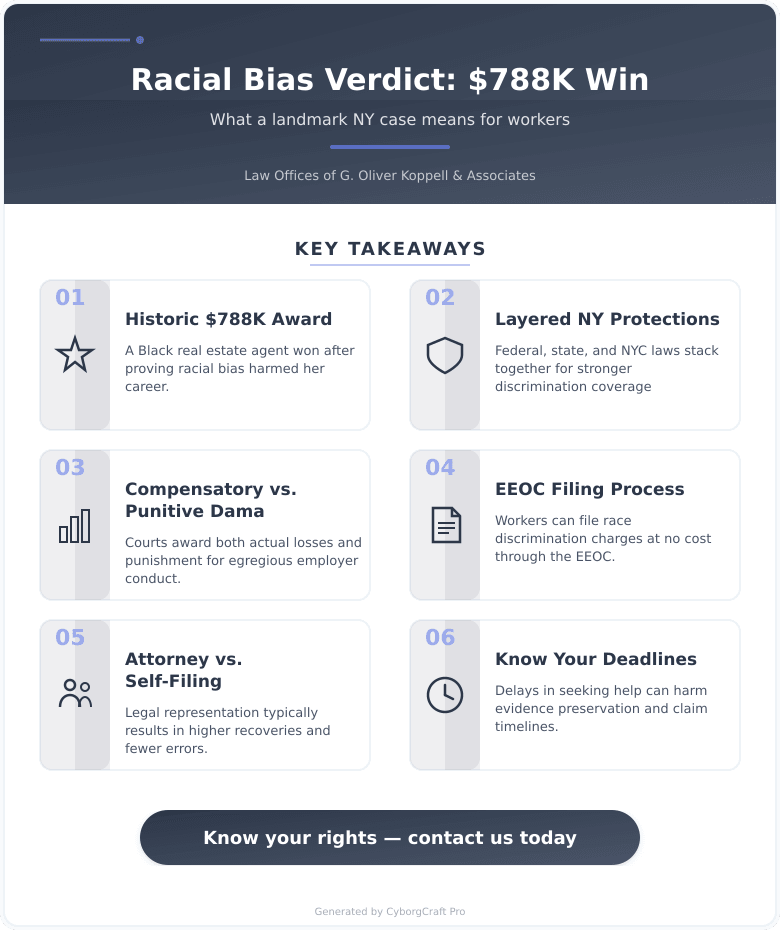
- Recent verdicts set a real benchmark – juries in New York are awarding substantial damages in proven racial bias cases
- New York law offers broader protections than federal law alone, especially for NYC workers covered by the City Human Rights Law
- The 300-day EEOC filing deadline is non-negotiable – document and act quickly
- Documentation is your strongest asset – start a written record the moment something happens
- Legal representation matters – early consultation consistently changes outcomes in discrimination cases
Frequently Asked Questions
How long does a racial bias claim take to resolve in New York?
Most racial discrimination claims in New York take anywhere from one to three years to fully resolve, depending on complexity and whether the case goes to trial. EEOC investigations alone can take 6-18 months before a right-to-sue letter is issued. Settlement negotiations can shorten this timeline significantly.
What damages can I recover in a New York racial bias case?
New York workers can recover back pay, front pay, compensatory damages for emotional distress, and in some cases punitive damages. The NYC Human Rights Law allows for uncapped emotional distress damages, which is one reason significant New York verdicts in racial bias cases are possible.
Do I need proof of intent to win a racial bias claim?
No – you do not need to prove your employer intended to discriminate, only that race was a factor in the adverse action taken against you. Courts look at patterns, statistics, and circumstantial evidence to establish discrimination without requiring a confession.
What is the filing deadline for a racial bias complaint in New York?
Under current New York law (2026), workers have 300 days from the discriminatory act to file an EEOC charge and three years to file under the NY State Human Rights Law. NYC Human Rights Law complaints must be filed within three years as well. Missing these windows can permanently bar your claim.
Can I be fired for filing a racial discrimination complaint?
Retaliation for filing a discrimination complaint is illegal under federal, state, and NYC law. If your employer fires, demotes, or otherwise punishes you for complaining about racial bias, that retaliation itself is a separate legal violation that can add to your damages.
How much does it cost to hire an employment discrimination attorney?
Many employment discrimination attorneys work on a contingency basis, meaning you pay no upfront fee and the attorney collects a percentage only if you win. Industry-standard contingency fees typically range from 25% to 40% of any recovery, though arrangements vary by case and attorney.
Ready to Understand Your Rights?
Racial bias in the workplace is serious, and recent verdicts prove New York courts agree. If you’ve experienced discrimination at work – in pay, promotions, assignments, or termination – you have legal options worth knowing about. The sooner you get clear information, the better your position.
Ready to take the next step? Contact us today for straight answers and real guidance on what your situation may mean legally. Don’t let filing deadlines or missing evidence reduce your options.
This content is for informational purposes only and does not constitute legal advice. For guidance specific to your situation, consult a qualified employment attorney licensed in New York.