
Hit by a Delivery E-Bike in Manhattan? The Surprising Answer to Who Pays Your Medical Bills
Delivery e-bike accidents in Manhattan are injuries caused when a motorized electric bicycle, typically ridden by a food or package courier, strikes a pedestrian or another cyclist on New York City streets. These crashes sit in a complicated legal space where standard no-fault insurance rules do not apply, leaving many injured New Yorkers confused about who actually covers their costs.
This guide focuses specifically on how injured pedestrians and cyclists in Manhattan can identify liable parties and recover medical expenses after a delivery e-bike collision.
E-bike collisions in New York City have increased in recent years alongside the growth of app-based delivery platforms. Reported crash data reflects ongoing concerns about rider and pedestrian safety across the city. If you were knocked down by a delivery rider in Midtown, the East Village, or anywhere else in Manhattan, the path to compensation is not obvious. Here is what you need to know.
Why Delivery E-Bike Accidents Break the Normal Insurance Rules
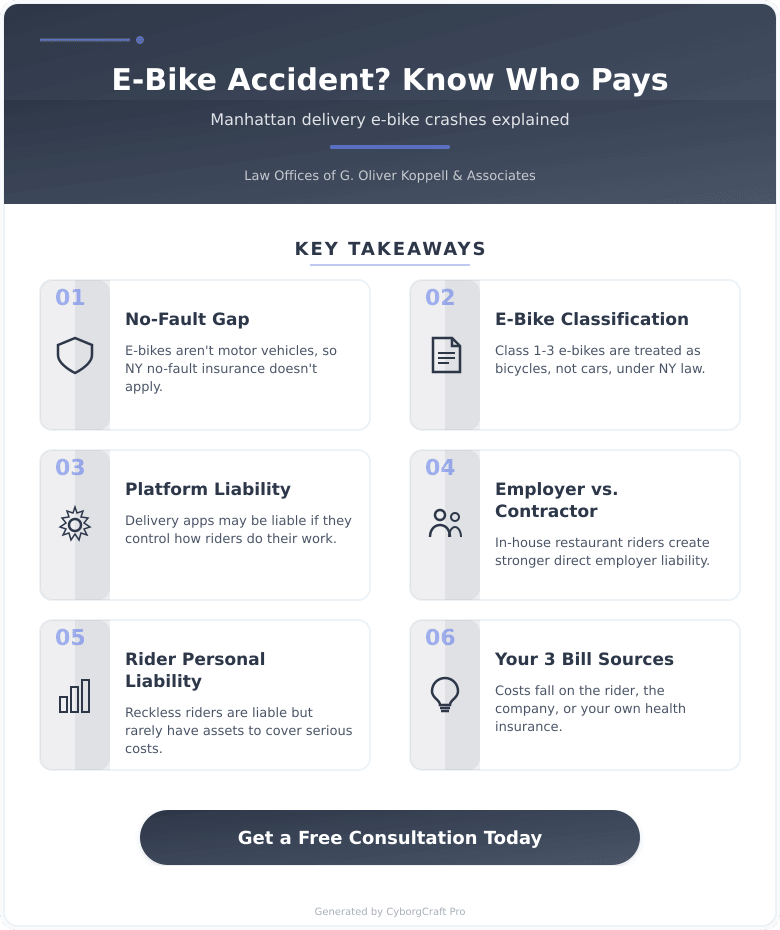
New York is a no-fault auto insurance state. Under normal circumstances, your own car insurance covers your initial medical bills after a vehicle accident, regardless of fault. But here is the catch: e-bikes are not classified as motor vehicles under New York insurance law. That means no-fault personal injury protection (PIP) does not automatically apply when a delivery e-bike hits you.
No-Fault Insurance Definition: A system where each party’s own insurer pays for initial medical expenses after a crash, without requiring proof of fault. New York’s no-fault rules apply to registered motor vehicles only, not e-bikes.
E-Bike Classification Definition: Under New York Vehicle and Traffic Law, Class 1, 2, and 3 e-bikes are treated as bicycles for most purposes, which excludes them from mandatory motor vehicle insurance requirements.
Because no-fault does not cover you here, your medical bills fall on one of three sources: the delivery rider personally, the company that employed or contracted the rider, or your own health insurance. The challenge is figuring out which applies to your situation and building a claim that actually holds up.
Thinking about this for your situation? Let’s talk. Contact us for a free consultation and we will walk you through your options with no pressure and no upfront cost.
Who Is Actually Liable After a Manhattan E-Bike Delivery Crash?
Liability depends heavily on the rider’s employment status and the platform they worked for. This is where things get genuinely surprising for most injury victims.
The Delivery Company
Major app-based delivery platforms have historically classified riders as independent contractors, not employees. That classification was designed, in part, to limit the company’s liability when a rider injures someone. But New York courts and regulators have pushed back. If a platform exercises significant control over how a rider works, courts can find grounds to hold the company responsible under doctrines like respondeat superior or negligent hiring.
The Restaurant or Retailer
If the restaurant hired its own in-house delivery staff rather than using a third-party app, the employer faces a stronger direct liability exposure. In-house employees acting within the scope of their job create clear employer liability under New York law.
The Rider Individually
If the rider operated recklessly, ran a red light, or rode on a sidewalk illegally, they carry personal liability. The practical problem is that individual riders rarely carry assets or insurance policies large enough to cover serious medical costs.
The E-Bike Owner
Sometimes the bike itself is owned or leased by the delivery platform. If a defect contributed to the crash, product liability claims against the manufacturer or distributor could be available.
Suing a Delivery Platform vs. Suing the Rider: Which Approach Works?
Where suing the delivery platform succeeds: Platforms have deeper pockets and carry commercial general liability or umbrella insurance policies. A successful employment reclassification argument opens access to that coverage. New York City regulations governing app-based delivery workers may support arguments that platforms exercise meaningful control over riders, which can strengthen liability claims.
Where suing the delivery platform fails: Independent contractor agreements create legal friction. Platforms invest heavily in defending contractor status. Proving the level of control needed to pierce that classification takes documentation and legal strategy.
Where suing the rider directly succeeds: If the rider was clearly negligent, a personal negligence claim is straightforward to establish. Evidence like traffic camera footage, witness statements, and police reports supports the case cleanly.
Where suing the rider directly fails: Individual riders often lack meaningful insurance or assets. Even a strong judgment can be difficult to collect. This path works best when paired with a platform claim or when the rider carries commercial insurance through their platform.
The verdict: For most injured pedestrians in Manhattan, pursuing both the rider and the delivery platform simultaneously is the most effective strategy. New York law allows claims against multiple defendants, and a thorough investigation often reveals facts that support platform liability even when the initial picture looks unclear.
| Liable Party | Typical Insurance Coverage | Strength of Claim | Best For |
|---|---|---|---|
| Delivery Platform | Commercial liability, umbrella | Strong with employment facts | Serious injuries with high bills |
| In-House Restaurant Employee | Employer’s general liability | Very strong | Injuries from restaurant-employed riders |
| Individual Rider | Rarely any relevant policy | Moderate (evidence-dependent) | Clear reckless conduct cases |
| E-Bike Manufacturer | Product liability policy | Strong if defect proven | Brake or mechanical failure crashes |
See how our approach compares when you review your specific circumstances. Our services page outlines how we approach liability investigations in delivery accident cases.
Your E-Bike Accident Action Plan
- Step 1 – Call 911 immediately: A police report creates an official record of the crash, the rider’s identity, and the platform they worked for. Without this document, building your case becomes significantly harder.
- Step 2 – Photograph everything: The bike, the rider, any visible injuries, skid marks, traffic signals, and the surrounding street. Time-stamp your photos. Surveillance cameras in Manhattan are everywhere, but footage is often overwritten within 48-72 hours.
- Step 3 – Collect rider and platform information: Get the rider’s name, phone number, and the name of the delivery app or restaurant they represent. Screenshot the order receipt if visible on their phone.
- Step 4 – Seek medical care the same day: Gaps in medical treatment weaken injury claims. Even if you feel okay initially, adrenaline masks pain. A same-day visit creates a contemporaneous medical record tied directly to the crash.
- Step 5 – Preserve your own records: Keep all medical bills, prescription receipts, and any documentation of missed work or altered daily activity.
- Step 6 – Consult an attorney before speaking to any insurer: Delivery platforms and their insurers have claims teams whose job is to minimize payouts. Speaking without legal guidance often results in statements that hurt your case.
Documents to Gather Before Your Consultation
- Police report or report number
- Photos and video from the scene
- Witness contact information
- Emergency room and follow-up medical records
- Bills from all treating providers
- Documentation of lost wages or income
- Screenshots of any delivery app or order confirmation
- Your own health insurance information
New York’s Statute of Limitations: The Deadline You Cannot Miss
Under New York law, most personal injury claims must be filed within three years of the date of the accident. That sounds like plenty of time, but evidence disappears fast. Delivery platform records, GPS data from the ride, and surveillance footage all have limited retention windows. The most common mistake injured people make is waiting months before speaking to an attorney, by which point critical evidence is gone.
According to the New York State Unified Court System, personal injury actions in New York are governed by CPLR Section 214, which sets that three-year window. Missing it typically means losing your right to sue entirely.
Recent shifts in how New York courts treat gig worker classification also matter here. Ongoing regulatory and legal developments have increased pressure on delivery platforms to reclassify riders, which could affect how liability arguments are structured going forward.
Frequently Asked Questions
Does New York no-fault insurance cover e-bike delivery accidents?
No, New York’s no-fault insurance does not cover injuries caused by e-bike delivery accidents. No-fault PIP benefits apply only to registered motor vehicles, and e-bikes are legally classified as bicycles under state law. Your recovery path depends on identifying a liable party with insurance or assets.
Can I sue a delivery app like DoorDash or Uber Eats if their rider hit me?
Yes, you may have a valid claim against the delivery platform depending on how much control they exercise over the rider’s work. New York courts evaluate the employment relationship based on multiple factors. If the platform sets routes, assigns orders, or controls working conditions, liability arguments become stronger.
What if the delivery rider ran a red light or rode on the sidewalk?
Traffic violations by the rider directly support a negligence claim against that rider personally and potentially against their employer. Sidewalk riding is illegal in Manhattan under New York City Administrative Code, and red-light violations create clear evidence of fault. Police reports and camera footage documenting these acts are valuable.
How long does an e-bike accident claim take to resolve in New York?
Most delivery e-bike injury claims in New York take between one and three years to resolve through settlement or trial. Cases involving clear liability and documented injuries often settle faster. Complex cases requiring platform liability arguments or significant damages calculations take longer.
What damages can I recover after a delivery e-bike crash?
Injured victims can potentially recover medical expenses, lost income, pain and suffering, and future care costs. New York does not cap compensatory damages in personal injury cases, so recovery depends on the severity of injuries and the strength of evidence.
What if the delivery rider had no insurance?
If the rider carries no personal insurance, your claim shifts toward the delivery platform or the restaurant employer. Your own uninsured motorist coverage will not apply here because e-bikes are not motor vehicles. This makes identifying company liability even more critical in these cases.
Should I accept a quick settlement offer from the delivery company?
Quick settlement offers from delivery platforms or their insurers are almost always lower than the full value of your claim. Early offers are made before the full extent of injuries is known. Consulting an attorney before accepting any offer protects your right to fair compensation.
What This Means for Manhattan Pedestrians Right Now
Manhattan’s streets carry more delivery e-bikes than ever before. The legal framework has not fully caught up with that reality, which creates genuine uncertainty for people injured in these crashes. The good news is that multiple avenues to compensation exist, and a thorough liability investigation often reveals options that are not obvious at first glance.
The team at Law Offices of G. Oliver Koppell & Associates works with injured New Yorkers across Manhattan and surrounding boroughs, helping clients understand their rights after complex accidents where standard insurance rules do not apply. If you or someone you know was struck by a delivery e-bike, do not assume there is no recourse. The answer to who pays your medical bills is often more accessible than it first appears.
For general guidance on bicycle and e-bike safety regulations in New York City, the NYC Department of Transportation e-bike resource page provides current classification rules and rider requirements.
Ready to understand your options? Contact us today for a free, no-obligation consultation. Evidence in e-bike cases disappears quickly, and acting early gives your case the best possible foundation.
Key Takeaways for Manhattan Accident Victims
- No-fault insurance does not apply – e-bikes are not motor vehicles under New York law, so standard PIP coverage is not available to you after this type of crash.
- Multiple defendants may be liable – the rider, the delivery platform, and the restaurant employer can all potentially share responsibility.
- Act fast to preserve evidence – surveillance footage, GPS data, and platform records disappear within days in many cases.
- The three-year statute of limitations is firm – missing that filing deadline ends your right to sue, regardless of how strong your case is.
- Early settlement offers are typically low – platforms and their insurers make quick offers to close claims before injuries are fully understood.