
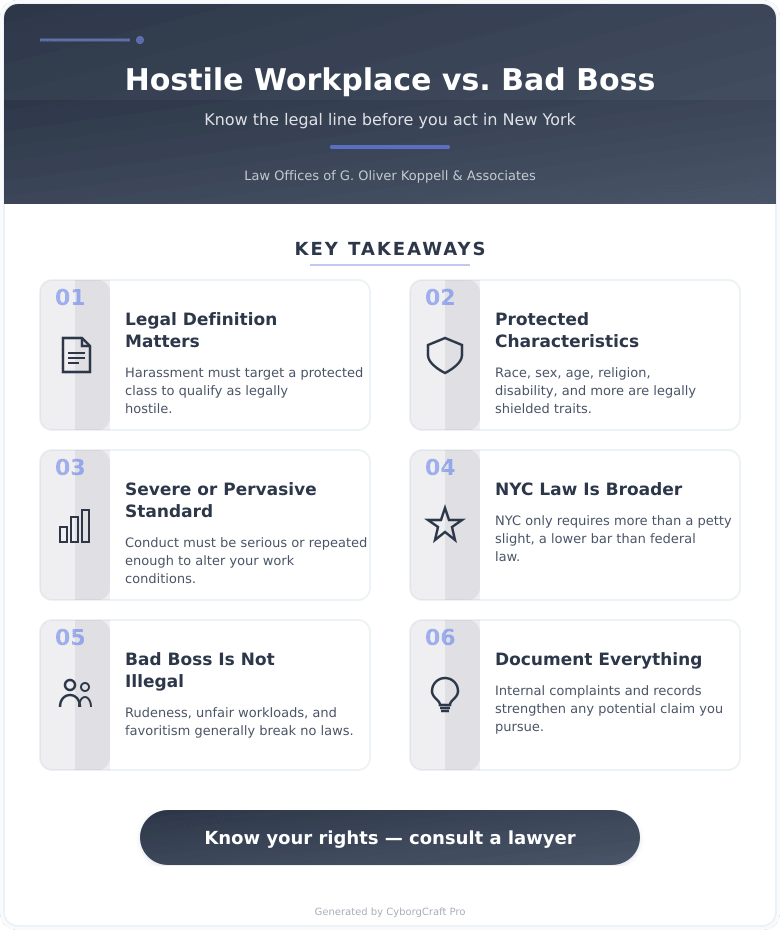
Hostile Work Environment vs Just a Bad Boss: The Legal Line New Yorkers Keep Getting Wrong
A hostile work environment is a legally defined condition in which workplace harassment based on a protected characteristic – such as race, sex, religion, age, or disability – is severe or pervasive enough to alter the terms of employment. Understanding this distinction matters because most workers in New York who feel mistreated at work actually have a different legal situation than they think.
This guide focuses specifically on helping New York workers understand the legal threshold between unlawful harassment and difficult workplace dynamics, so they can make informed decisions about their rights.
Hostile Work Environment Definition: A hostile work environment is a form of workplace harassment prohibited under federal law and New York State and City law, occurring when conduct targeting a protected class is so severe or pervasive that it creates an abusive working condition a reasonable person would find intolerable.
Here is the thing most people miss: your boss can be rude, unfair, demanding, or even cruel without breaking a single law. New York does not require employers to be kind. The law draws a very specific line, and where that line falls surprises a lot of workers who come in convinced they have an open-and-shut case.
What Actually Makes a Work Environment Legally Hostile
The most common mistake workers make is assuming that being treated badly at work equals a hostile work environment claim. Courts do not see it that way. According to guidance from the U.S. Equal Employment Opportunity Commission, harassment must be based on a legally protected characteristic to qualify as actionable.
Protected characteristics under New York law include:
- Race, color, and national origin
- Sex and gender identity
- Age (40 and older under federal law; any age under NYC law)
- Religion or creed
- Disability status
- Sexual orientation
- Pregnancy and caregiver status
- Immigration status (under NYC Human Rights Law)
New York City’s Human Rights Law is actually broader than federal law in several important ways. The NYC standard only requires that harassment be more than what a petty slight or trivial inconvenience would look like – a lower bar than the federal “severe or pervasive” standard. Recent shifts in how New York courts interpret the city law have made it meaningfully easier to bring a claim in the five boroughs than elsewhere in the state.
Pattern recognition note: The most common mistake workers make is confusing a manager’s general meanness with targeted harassment. If your boss yells at everyone equally, that is not a protected class claim. If your boss singles you out with comments about your age, ethnicity, or religion, that changes the picture entirely.
Hostile Work Environment vs Bad Boss: Which Approach Works?
Where a hostile work environment claim succeeds: The conduct is tied to a protected characteristic, it is repeated or severe enough to affect your ability to do your job, and your employer knew or should have known and failed to act. Courts have upheld claims where a single incident of extreme severity – such as a physical assault – also qualifies.
Where a hostile work environment claim fails: The harassment is general or applies equally to everyone regardless of background. The conduct is rude but isolated. There is no connection between the treatment and a legally protected trait.
Where a “bad boss” situation succeeds at motivating change: Internal HR complaints, documentation, and performance improvement processes can shift workplace dynamics without litigation. Some employers respond quickly to formal internal complaints.
Where a “bad boss” situation fails as a legal claim: Unfair scheduling, excessive workload, harsh criticism, and playing favorites are generally not illegal. Courts repeatedly hold that employment law is not a general civility code.
The verdict: If your poor treatment connects directly to who you are rather than what you did, you may have a legal claim. If it does not, documentation and internal escalation are your most practical tools. Getting a legal read on your specific facts early is the clearest way to know which path fits your situation.
Thinking about whether your situation crosses the legal line? Let’s talk. At the Law Offices of G. Oliver Koppell & Associates, we walk New Yorkers through their options with no pressure and straight answers. Contact us to start the conversation.
Your Hostile Work Environment Action Plan
- Step 1 – Document everything: Write down dates, times, specific words used, and witnesses present for every incident. Courts rely heavily on contemporaneous records, and memories fade under stress.
- Step 2 – Report internally: File a written complaint with HR or a supervisor above the harasser. This step is legally significant – employers can sometimes escape liability if they were never given notice. Keep a copy of everything you submit.
- Step 3 – Understand your deadlines: Under federal law, you generally have 300 days to file a charge with the EEOC in New York. Under the New York State Human Rights Law, the deadline is three years. NYC Human Rights Law also allows three years. Missing these windows can bar your claim entirely.
- Step 4 – Consult an attorney before filing: The choice of forum – federal EEOC, New York State Division of Human Rights, or NYC Commission on Human Rights – affects your options going forward. An attorney can help you pick the right path before you commit.
- Step 5 – Preserve evidence: Save emails, texts, voicemails, and any written performance reviews. Do not delete anything, even if it feels embarrassing or unrelated.
What New York Law Requires Your Employer to Do
New York State generally requires all employers to adopt a sexual harassment prevention policy and provide annual training, regardless of size. That requirement has been in place since 2018 and remains active. If your employer skipped this step, it is relevant context in any legal proceeding.
Employers are automatically liable for harassment by supervisors in many circumstances. They may avoid liability for co-worker harassment only if they can show they had a reasonable complaint process and the employee failed to use it. This is why internal reporting matters so much before you reach the legal stage.
According to EEOC data, workplace harassment charges in New York represent a consistent share of the national total, with sex-based and race-based charges most frequently filed. Recent data shows that workers who document early and report formally recover significantly better outcomes than those who wait.
| Legal Standard | Federal Law (Title VII) | NY State HRL | NYC Human Rights Law |
|---|---|---|---|
| Covered employers | 15+ employees | 4+ employees | 4+ employees (1+ for some claims) |
| Harassment threshold | Severe or pervasive | More than petty slight | More than petty slight |
| Filing deadline | 300 days | 3 years | 3 years |
| Where to file | EEOC | NY Division of Human Rights or court | NYC Commission on Human Rights or court |
Preparation Checklist Before a Legal Consultation
- ☐ Written timeline of incidents with dates and details
- ☐ Copies of any emails or messages containing harassing content
- ☐ Names of any witnesses who observed incidents
- ☐ Copies of your HR complaint and employer’s response, if any
- ☐ Your employment contract or offer letter
- ☐ Any performance reviews from before and after harassment began
- ☐ Your employer’s written harassment policy, if one was provided
Seeing this list and realizing you need help pulling it together? Reach out to us – we help New Yorkers get organized before their first consultation so nothing important gets missed. For a full overview of what we handle, visit our services page.
Key Takeaways for New York Workers in 2026
- Bad treatment is not the same as illegal treatment – the law requires a connection to a protected characteristic
- NYC law is more protective than federal law – the threshold to prove harassment is lower in the five boroughs
- Deadlines are strict – missing the filing window ends your legal options regardless of merit
- Internal reporting matters – it builds your case and can trigger employer liability
- Documentation is your strongest asset – start a written log the same day an incident occurs
Frequently Asked Questions
What is the legal definition of a hostile work environment in New York?
A hostile work environment in New York is workplace harassment tied to a protected characteristic that is severe or pervasive enough to affect the terms or conditions of employment. Under NYC law, the bar is even lower – conduct only needs to exceed a petty slight or trivial inconvenience. Both the New York State Human Rights Law and the NYC Human Rights Law offer broader protections than federal Title VII.
Can I sue my employer just for having a bad boss?
No – a manager who is rude, unfair, or abusive does not automatically create a legal claim unless the mistreatment is connected to a legally protected characteristic. New York courts consistently hold that employment law does not require employers to maintain a polite or fair workplace in a general sense. The conduct must target you because of race, sex, age, disability, religion, or another protected trait.
How long do I have to file a hostile work environment claim in New York?
Under the NYC and New York State Human Rights Laws, you generally have three years from the discriminatory act to file a complaint. Federal claims through the EEOC carry a 300-day deadline in New York. Because these deadlines run concurrently and the choice of forum affects your options, getting legal advice before filing is strongly recommended.
Does the harassment have to be physical to count?
No – verbal comments, written messages, images, and other non-physical conduct can all create a hostile work environment claim. Courts look at the totality of the circumstances, including how frequent the conduct is, how severe it is, and whether it unreasonably interferes with work performance.
What if HR ignored my complaint?
An employer’s failure to respond to a formal harassment complaint can significantly strengthen your legal position. Document the date you filed, what you submitted, and any response – or non-response – you received. This record directly addresses the employer’s potential defense that it had no knowledge of the harassment.
How much does it cost to pursue a hostile work environment claim?
Many employment attorneys handle hostile work environment cases on a contingency basis, meaning no fee is owed unless the case resolves in your favor. General industry context: hourly rates for employment lawyers in New York City range from $300 to $600 per hour (2026 market rates), but contingency arrangements are common for discrimination and harassment claims. Always ask about fee structure during your first consultation.
What is the difference between the EEOC and the NYC Commission on Human Rights?
The EEOC handles federal claims under Title VII, while the NYC Commission on Human Rights enforces the NYC Human Rights Law, which provides broader protections and a different complaint process. Filing with one agency does not automatically preserve your rights with the other, so understanding which forum fits your specific situation before you file is critical.
What This Means for You Right Now
The difference between a bad boss and an illegal hostile work environment is a legal distinction with real consequences for your case and your career. New York offers some of the strongest worker protections in the country – but only workers who understand the rules can use them effectively.
If you work in Manhattan, the Bronx, Brooklyn, Queens, Staten Island, or anywhere across the New York metro area and you believe your workplace crosses the legal line, the time to act is now. Deadlines run whether or not you are ready, and evidence gets harder to preserve with every passing week.
Ready to get a straight answer about your situation? Contact the Law Offices of G. Oliver Koppell & Associates today. We will walk you through what the law actually requires, what your facts look like against that standard, and what your real options are. No pressure, no vague promises – just honest legal guidance from people who know New York employment law.