
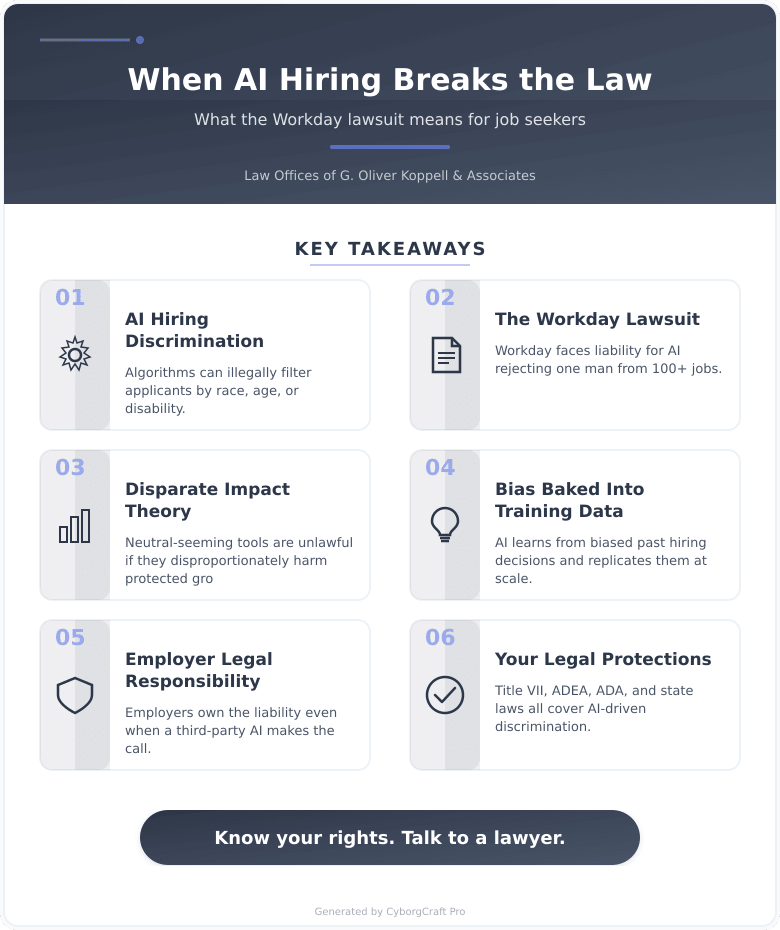
The AI That Rejected You From 100 Jobs Could Be Breaking the Law – Inside the Workday Discrimination Case
AI hiring discrimination occurs when an automated screening system filters out job applicants based on characteristics protected under federal or state civil rights law, such as age, race, disability, or national origin. The consequences can affect thousands of candidates before a single human reviewer ever sees a resume.
This guide focuses specifically on how AI-driven hiring tools create legal liability for employers, what the Workday lawsuit reveals about systemic bias, and what your rights are as a job seeker in 2026.
AI Hiring Discrimination Definition: The use of automated or algorithmic screening tools that disproportionately exclude job applicants based on legally protected characteristics, triggering potential liability under Title VII, the ADEA, and the ADA.
What the Workday Lawsuit Actually Alleges
A federal lawsuit filed against Workday – one of the most widely used HR software platforms in the country – put a sharp spotlight on a practice that had been quietly shaping hiring outcomes for years. The plaintiff, Derek Mobley, alleged that Workday’s AI screening tools rejected him for over 100 jobs, and that the system’s algorithms embedded discriminatory patterns based on race, age, and disability status.
What makes this case significant is the legal theory. Mobley’s attorneys argued that Workday should be treated as an employment agency under Title VII of the Civil Rights Act, the Age Discrimination in Employment Act (ADEA), and the Americans with Disabilities Act (ADA). That argument would make Workday directly liable for discriminatory screening outcomes, not just the employers who purchased the software.
Disparate impact theory: A legal doctrine holding that a facially neutral policy or tool can be unlawful if it produces a statistically disproportionate negative effect on a protected class, even without any intent to discriminate.
Automated hiring tools are widely reported to screen out large numbers of resumes before any human review takes place. When those tools carry embedded bias from flawed training data, entire demographics can be systematically excluded from the workforce.
How AI Screening Builds In Bias Without Anyone Noticing
Here is the uncomfortable truth about algorithmic hiring: these tools learn from historical data. If past hiring decisions at a company favored younger workers, candidates without employment gaps, or graduates from specific schools, the AI replicates those patterns at scale.
The most common mistake we see in discrimination claims involving AI tools is the assumption that automation equals neutrality. It does not. A system trained on biased outcomes produces biased predictions – and the employer still owns the legal exposure.
Recent shifts in federal enforcement reflect this. The Equal Employment Opportunity Commission (EEOC) has issued guidance clarifying that employers remain responsible for discriminatory outcomes produced by third-party hiring software. That responsibility does not transfer to the vendor simply because a machine made the call.
Thinking about whether your situation might involve unlawful hiring practices? Contact us for a direct conversation about your options. No pressure, no obligation.
Legal Protections vs. AI Screening Tools: How They Compare
| Legal Claim | Statute | Protected Class | Who Can Sue |
|---|---|---|---|
| Racial Discrimination | Title VII (1964) | Race, Color, National Origin | Employees and Applicants |
| Age Discrimination | ADEA (1967) | Workers 40 and older | Employees and Applicants |
| Disability Discrimination | ADA (1990) | Qualified individuals with disabilities | Employees and Applicants |
| New York State Protection | NYSHRL (2026) | Broader protected classes under NY law | Employees and Applicants in NY |
New York provides some of the strongest protections in the country. The New York State Human Rights Law covers employers with four or more employees, and New York City’s local law goes even further. Local Law 144 in New York City, effective since 2023, requires employers using automated employment decision tools (AEDTs) to conduct and publish independent bias audits annually. That requirement is one of the first of its kind in the United States.
Employer Liability vs. Vendor Liability: Which Approach Works?
Where employer liability succeeds: Employers are well-established targets under Title VII and the ADEA. Courts have long held that the discriminatory effect of a hiring practice, regardless of who designed it, belongs to the employer. This gives plaintiffs a proven legal pathway.
Where employer liability fails: Individual employers may argue they relied in good faith on a certified third-party tool, creating difficult causation questions. Damages can also be harder to quantify when no human decision-maker is identified.
Where vendor liability succeeds: Holding platforms like Workday directly accountable would dramatically expand deterrence. A single successful case could change how every major HR tech company builds and tests its products.
Where vendor liability fails: Courts have not uniformly accepted the theory that SaaS vendors qualify as employment agencies under federal civil rights statutes. The Workday case itself faced early procedural challenges on exactly this question.
The verdict: Pursuing claims against both the employer and the vendor is a well-supported approach under current law. Federal and New York state law support claims against employers, while the vendor theory remains viable and is gaining traction in federal courts.
Your AI Hiring Discrimination Action Plan
- Step 1 – Document Everything: Save every rejection notice, application confirmation, and any communication from the employer or their platform. Timestamps matter in discrimination cases.
- Step 2 – Request Information: In New York City, Local Law 144 imposes notice and audit requirements on employers who use AEDTs. Know your rights under Local Law 144 and what obligations employers have when using these tools.
- Step 3 – File an EEOC Charge: Before pursuing a federal discrimination lawsuit, you must file a charge with the Equal Employment Opportunity Commission. In New York, you generally have 300 days from the discriminatory act to file.
- Step 4 – Explore State Law Claims: New York State and New York City human rights claims can run parallel to federal claims and often offer broader remedies.
- Step 5 – Consult an Attorney: AI discrimination cases involve technical evidence, statistical analysis, and evolving legal standards. Getting legal guidance early protects your options.
What New York Job Seekers Should Know Right Now
If you have applied for jobs in New York City and received automated rejections from multiple employers using the same HR platform, that pattern may be legally significant. Firms that document consistent rejection patterns across protected class lines are finding more receptive courts in 2026 than at any point in the past decade.
At Law Offices of G. Oliver Koppell & Associates, located at 99 Park Ave in New York, NY, we follow these developments closely and understand the challenges facing job seekers navigating a hiring system that increasingly relies on automated tools. Reach out to us to discuss what you experienced and whether your situation warrants further review.
For a full overview of how we approach employment-related legal matters, visit our services page.
Key Takeaways for New York Job Seekers in 2026
- AI tools carry real legal exposure – Employers cannot outsource their civil rights obligations to an algorithm.
- New York law is stronger than federal law – Local Law 144 creates specific rights around automated hiring tools in NYC.
- You have a 300-day window – Do not wait to document and file if you believe you were discriminated against.
- Patterns matter – One rejection is not a case. Repeated rejections across similar roles using the same platform can be.
- Vendor liability is evolving – The Workday case may reshape how courts treat HR tech companies in discrimination suits.
Frequently Asked Questions
What is AI hiring discrimination and how does it happen?
AI hiring discrimination occurs when an automated screening tool produces outcomes that disproportionately disadvantage applicants based on protected characteristics like age, race, or disability. It typically results from training data that reflects historical bias in past hiring decisions, which the algorithm then replicates at scale.
Is Workday legally responsible for discriminatory hiring outcomes?
The Workday case argues that HR software vendors can be held directly liable as employment agencies under Title VII, the ADEA, and the ADA. Courts have not uniformly resolved this question, but the litigation is actively shaping how vendor liability will be treated in future AI discrimination cases.
What is New York City’s Local Law 144?
Local Law 144 requires New York City employers to conduct independent bias audits of any automated employment decision tools they use and to publish those results publicly. It also gives applicants the right to request information about whether an AEDT was used in their hiring process. The law has been in effect since 2023.
How long do I have to file an AI discrimination claim in New York?
In New York, you generally have 300 days from the date of the discriminatory act to file a charge with the EEOC. State and city law claims may have different deadlines, so acting quickly and consulting an attorney preserves your options.
What evidence do I need for an AI hiring discrimination case?
Useful evidence includes rejection notices, application records, timestamps, the name of the HR platform used, and any pattern of rejections across multiple employers using the same tool. Statistical evidence comparing your qualifications to hired candidates is often central to these cases.
Can I sue both the employer and the AI vendor?
Yes, pursuing claims against both the employer and the vendor is legally possible and increasingly common in 2026. Employers retain liability under established civil rights law, while vendor liability under the employment agency theory continues to develop through ongoing litigation.
Do I need a lawyer to file an AI discrimination complaint?
You can file an EEOC charge without an attorney, but AI discrimination cases involve technical evidence and evolving legal theories that benefit from professional guidance. An attorney can help you build the strongest possible record before you file and identify all available claims under federal, state, and local law.