
The Hidden Deadline That Can Kill Your Injury Claim: New York’s Three-Year Statute of Limitations Explained
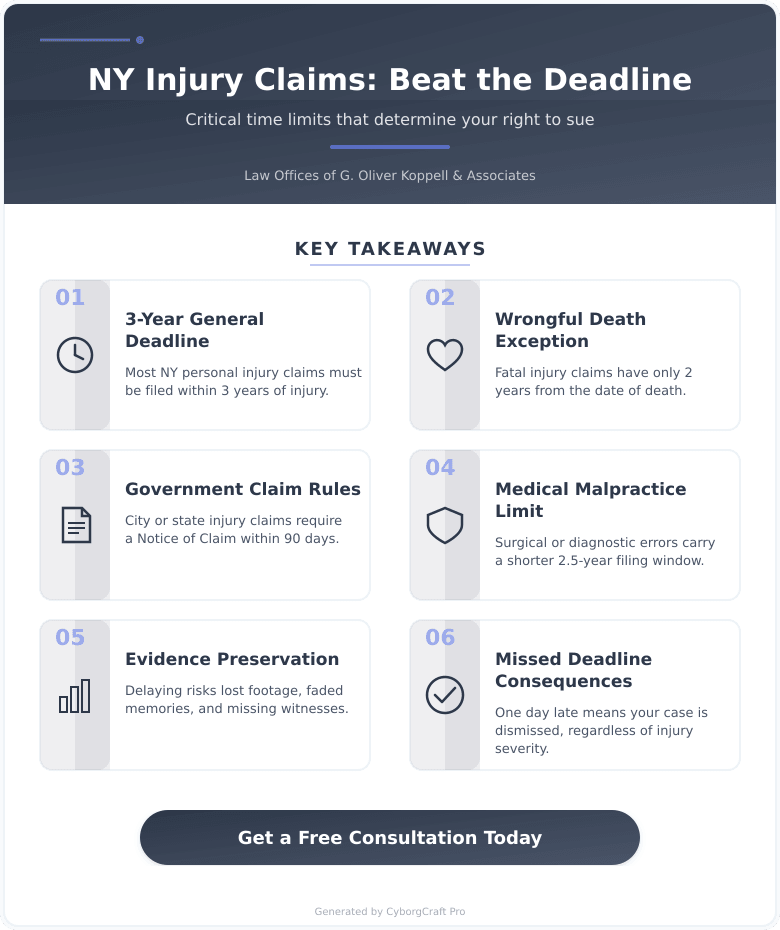
New York’s statute of limitations for personal injury claims is a strict legal deadline that gives injured parties three years from the date of injury to file a lawsuit in court. Missing this deadline almost always means losing your right to compensation permanently, regardless of how serious your injuries are.
This guide focuses specifically on how New York’s three-year statute of limitations works, who it applies to, and what exceptions could extend or shorten your window to act.
Statute of Limitations Definition: A statute of limitations is a state law that sets the maximum time period after an event within which a legal claim may be filed – once it expires, the court will typically dismiss your case outright.
Most people who come in after a car crash or slip-and-fall assume they have plenty of time. The reality? The clock starts ticking the moment you’re hurt. Under New York Courts procedural rules, even a valid, well-documented claim gets thrown out if filed one day late. The most common mistake attorneys see is injured people waiting too long because they assumed an insurance settlement would come through – and it never did.
New York’s Statute of Limitations: The Core Rules
New York Civil Practice Law and Rules (CPLR) Section 214 sets the general three-year deadline for most personal injury cases. That includes car accidents, slip-and-fall incidents, dog bites, and similar claims. The clock starts on the date the injury occurred – not the date you discovered it, not the date you hired an attorney.
Injury claim deadline: Three years from the date of injury for most standard personal injury claims in New York (2026).
Wrongful death deadline: Two years from the date of death, not the date of the underlying injury – a critical distinction families often miss.
Missed filing deadlines are a recognized cause of dismissed personal injury cases in New York. That’s not a technicality – it’s a case-ending outcome.
When the Standard Three Years Does Not Apply
Here’s where things get complicated. Several exceptions shorten or extend the standard deadline, and knowing which one applies to your situation can be the difference between a viable claim and none at all.
| Claim Type | Deadline | Key Note | Best For |
|---|---|---|---|
| General personal injury | 3 years | Starts on injury date | Car accidents, slip-and-fall |
| Wrongful death | 2 years | Starts on date of death | Fatal injury cases |
| Medical malpractice | 2.5 years | From act or last treatment | Surgical or diagnostic errors |
| Claims against NYC government | 1 year + 90 days | Notice of claim required within 90 days | City-owned property injuries |
| Claims against NY State | 90 days to file notice | Filed with Court of Claims | State agency injuries |
Claims against a New York City agency or municipal entity carry an even tighter restriction. You must file a Notice of Claim within 90 days of the injury before you can even begin a lawsuit. Miss that 90-day window and your government liability case is effectively over. According to CDC injury data, falls and traffic incidents account for a substantial share of injury claims – many of which occur on government-maintained property.
Thinking About This for Your Situation? Let’s Talk.
Deadlines this strict deserve a direct conversation. Contact us at the Law Offices of G. Oliver Koppell & Associates for a free consultation – no pressure, no obligation. We’ll walk you through exactly where your claim stands right now.
Waiting vs. Acting: What the Delay Actually Costs You
Where waiting succeeds: Giving your injuries time to fully manifest before settlement discussions means you won’t undersell long-term medical needs.
Where waiting fails: Evidence disappears, witnesses forget details, and surveillance footage can be deleted after an incident.
Where acting quickly succeeds: Preserves evidence, locks in witness statements, and puts insurance companies on notice early.
Where acting too quickly fails: Settling before understanding your full medical picture can lock you into a number that doesn’t cover future treatment.
The verdict: Hire an attorney early to preserve your claim and protect evidence, but don’t rush to settle until your medical outlook is clear. These two goals are not in conflict – a good attorney manages both.
Your Statute of Limitations Action Plan
- Step 1 – Identify your injury date: Write down the exact date of the incident. This is the starting point for your deadline calculation.
- Step 2 – Determine the defendant type: Is the responsible party a private individual, a business, New York City, or New York State? Government claims have much shorter notice requirements.
- Step 3 – Check for exceptions: Review whether you were a minor at the time, whether the injury was a latent condition, or whether fraud was involved – all can affect your deadline.
- Step 4 – Preserve evidence immediately: Photographs, medical records, incident reports, and witness contact info should be secured now, not later.
- Step 5 – Consult an attorney before the deadline: Courts in New York give almost no relief for missed statutes of limitations. Do not wait until the last month.
Serving clients throughout Manhattan, the Bronx, Brooklyn, Queens, and Staten Island, the Law Offices of G. Oliver Koppell & Associates handles injury claims across all five boroughs and surrounding New York communities. Our office at 99 Park Ave in Midtown Manhattan is accessible to clients from across the metro area.
Common Mistakes That Kill Valid Claims
- Assuming the insurance company’s cooperation means you don’t need to file suit
- Missing the 90-day Notice of Claim requirement for government defendants
- Confusing the date of discovery with the date of injury for standard claims
- Waiting until physical therapy ends before contacting an attorney
- Not accounting for the shorter two-year window in wrongful death cases
Key Takeaways for New York Injury Victims in 2026
- Three years is the standard rule – but several claim types carry shorter deadlines that catch people off guard
- Government claims are the most dangerous – the 90-day Notice of Claim requirement is unforgiving
- The clock starts on injury date – not when you hired a lawyer or discovered the full extent of harm
- Evidence has its own deadline – waiting costs you proof even if you’re still within the legal window
- 2026 brings no changes to core deadlines – but procedural rules and court filing requirements continue to evolve
Frequently Asked Questions
What is the statute of limitations for personal injury in New York?
New York’s statute of limitations for most personal injury claims is three years from the date of injury. This deadline is set by CPLR Section 214 and applies to cases like car accidents and slip-and-fall injuries. Missing it almost always results in permanent dismissal.
Does the deadline change if the defendant is a government agency?
Yes – claims against New York City or other municipal entities require a Notice of Claim within 90 days of the injury. This is separate from and much shorter than the standard three-year limit. Failing to file that notice on time bars your lawsuit entirely.
What happens if I was a minor when I was injured?
New York’s statute of limitations is generally tolled (paused) for minors until they turn 18. That means the three-year clock typically starts on their 18th birthday, giving them until age 21 to file. Government claim notice requirements may still apply differently.
How long do I have for a medical malpractice claim in New York?
Medical malpractice claims in New York carry a two-and-a-half-year statute of limitations. The deadline runs from the date of the negligent act or from the end of continuous treatment by the same provider. This is shorter than the standard injury deadline, so acting quickly matters.
Can the statute of limitations be extended in New York?
Certain circumstances can toll or extend the deadline, including the injured party being a minor, suffering from a legal disability, or when fraud concealed the injury. These exceptions are narrow and fact-specific. Never assume an extension applies without confirming it with an attorney.
What should I bring to my first attorney consultation?
Bring documentation of the incident date, any medical records or bills, photos of the scene or injuries, insurance correspondence, and any police or incident reports. Having these ready helps an attorney immediately assess where your deadline stands and what evidence needs to be preserved.
Your Next Step Starts Now
Every day that passes after an injury is a day closer to a deadline that courts will not bend. New York’s statute of limitations rules exist to protect defendants from stale claims – but they can just as easily end a perfectly valid case that was simply filed too late.
Ready to find out exactly where your claim stands? Reach out to us today for a free, no-obligation consultation. The team at Law Offices of G. Oliver Koppell & Associates will give you straight answers about your timeline and your options – because knowing where you stand is the first step toward protecting your rights. Visit our services page to learn more about how we can help.
This content is for informational purposes only and does not constitute legal advice. For guidance specific to your situation, consult a licensed New York attorney.